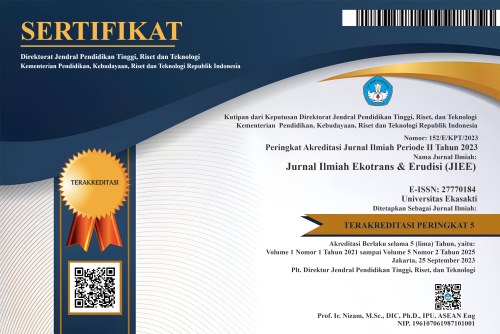
Accreditation and Certificate
Jurnal Ilmiah Ekotrans & Erudisi (JIEE) is committed to maintaining the integrity, reliability, transparency, and credibility of the scholarly record. The journal recognizes that responsible scientific publishing requires effective procedures for identifying, evaluating, investigating, and responding to allegations of research and publication misconduct.
JIEE does not tolerate research misconduct, unethical publication practices, or deliberate attempts to manipulate the scholarly communication process. The journal is committed to addressing concerns fairly, objectively, confidentially where appropriate, and in accordance with internationally recognized principles of publication ethics.
This policy establishes the procedures for reporting suspected misconduct, conducting preliminary editorial assessments, requesting explanations, referring allegations for institutional investigation, determining appropriate editorial actions, and safeguarding the integrity of submitted and published research.
The policy is informed by guidance from the Committee on Publication Ethics (COPE) and the Principles of Transparency and Best Practice in Scholarly Publishing developed by COPE, the Directory of Open Access Journals (DOAJ), the Open Access Scholarly Publishing Association (OASPA), and the World Association of Medical Editors (WAME).
The primary purpose of this policy is to establish a transparent and consistent framework for addressing allegations that may compromise the reliability, originality, authenticity, or ethical integrity of scholarly work submitted to or published in JIEE.
This policy applies to:
Concerns may be considered regardless of when the relevant research was conducted or when the article was submitted or published, subject to the availability of evidence and applicable institutional or legal requirements.
Research misconduct refers to serious departures from accepted standards of research integrity and responsible scholarly communication.
JIEE recognizes fabrication, falsification, plagiarism, citation manipulation, and other serious irregularities as matters requiring appropriate editorial assessment. The applicable definition and determination of formal research misconduct may also depend on institutional regulations and relevant legal frameworks.
Fabrication involves making up research data, observations, participant responses, interview records, experimental results, documents, or other research evidence and presenting them as genuine findings.
Examples include:
Falsification involves intentionally or improperly manipulating research materials, procedures, data, analyses, or results so that the research record no longer accurately represents the work conducted.
Examples include:
Plagiarism involves presenting another person's words, ideas, research findings, analytical frameworks, images, data, or other intellectual contributions as one's own without appropriate acknowledgment.
Potential forms of plagiarism include:
Textual similarity alone does not establish plagiarism. Similarity reports must be evaluated in context, considering quotation practices, disciplinary terminology, properly cited material, and the nature of the overlap.
Redundant or duplicate publication may occur when substantially overlapping research findings, data, or manuscripts are published or submitted more than once without adequate disclosure, justification, or appropriate cross-referencing.
Unacceptable practices may include simultaneous submission of the same manuscript to multiple journals, undisclosed duplicate publication, and inappropriate fragmentation of a single research project into multiple publications lacking independent scholarly contributions.
Legitimate secondary publication, dissemination of preprints, or reuse of previously disclosed materials must be evaluated according to the journal's applicable policies, disclosure requirements, copyright obligations, and the scholarly context.
Citation manipulation refers to inappropriate attempts to influence citation counts, bibliometric indicators, or perceived scholarly impact through citations that lack genuine academic relevance.
Examples include:
Editors and reviewers may recommend additional references when they are scientifically relevant and necessary to strengthen the manuscript. Such recommendations must be justified by scholarly considerations rather than personal or institutional citation interests.
Authorship misconduct includes the inappropriate assignment, omission, sale, purchase, or manipulation of authorship credit.
Examples include gift authorship, guest authorship, ghost authorship, coercive authorship, false author contributions, and unauthorized changes to the authorship list.
Authorship-related concerns are evaluated with reference to the journal's Authorship Criteria and Publication Ethics policies. Where disputes require formal determination of individual contributions, the journal may refer the matter to the relevant institution.
Peer review misconduct includes attempts to undermine the independence, confidentiality, authenticity, or fairness of manuscript evaluation.
Examples include:
Allegations involving editors or reviewers must be assessed independently of the individuals concerned.
Research ethics concerns may include failure to obtain required ethical approval, inappropriate handling of personal information, misrepresentation of informed consent, unauthorized disclosure of confidential data, or research procedures that violate applicable institutional and ethical requirements.
The necessity and form of ethical approval depend on the research design, participant involvement, institutional requirements, and applicable regulations.
The use of artificial intelligence-assisted technologies may raise research integrity concerns when such tools are used to fabricate evidence, generate fictitious references, conceal substantive methodological processes, misrepresent original contributions, or compromise confidential research information.
Authors remain accountable for the accuracy and integrity of AI-assisted content. The use of AI tools must comply with the journal's applicable disclosure requirements and editorial policies.
AI-generated content indicators or automated detection results must not be treated as conclusive proof of misconduct without appropriate contextual evaluation and supporting evidence.
JIEE adopts the following principles when responding to suspected research or publication misconduct:
JIEE encourages authors, reviewers, editors, researchers, readers, research institutions, and other interested parties to report credible concerns about potential research or publication misconduct.
Reports should be submitted to the journal's editorial office through the official contact information available on the Contact page.
To facilitate a meaningful assessment, a report should include, where reasonably available:
Reports should be presented in good faith and should distinguish observable evidence from interpretation or speculation.
The journal may consider anonymous allegations when they contain sufficiently specific and verifiable information. Anonymous reports are evaluated on the credibility of their evidence rather than the identity of the individual submitting them.
General accusations unsupported by identifiable evidence may not be sufficient to initiate a substantive investigation. Where appropriate, the editorial office may request additional information before proceeding.
Upon receiving an allegation, the Editor-in-Chief or another appropriately designated editor will conduct an initial assessment to determine whether the concern falls within the journal's responsibilities and warrants further examination.
The initial assessment may include:
The initial editorial assessment is not equivalent to a formal institutional finding of research misconduct.
Where concerns involve specialized methodologies, statistics, datasets, or technical evidence, the journal may seek independent expert advice from qualified individuals without relevant conflicts of interest.
When the initial assessment identifies concerns requiring explanation, the responsible editor will ordinarily contact the corresponding author and provide a sufficiently clear description of the issues identified.
The author may be requested to provide:
Authors must be provided a reasonable opportunity to respond before an adverse editorial determination is made, except where immediate protective action is necessary or applicable requirements justify a different procedure.
The corresponding author is expected to communicate relevant concerns to the other authors and coordinate a complete and accurate response.
The editorial team may request direct clarification from individual co-authors when necessary.
Failure to provide an adequate response may be considered in evaluating whether a manuscript or publication can be regarded as sufficiently reliable. However, a failure to respond does not, by itself, establish intentional research misconduct.
JIEE recognizes the distinction between editorial responsibility for published content and institutional responsibility for investigating the conduct of researchers.
Where allegations involve potentially serious research misconduct requiring formal investigation, the journal may refer the concern and relevant supporting evidence to the appropriate institution, research integrity office, or authorized body.
The institution is generally responsible for determining whether its researchers have committed misconduct under applicable institutional rules and research integrity procedures.
The journal remains responsible for determining appropriate editorial and publication actions concerning material submitted to or published by JIEE.
Institutional cooperation may include:
The journal will not ordinarily attempt to replace a formal institutional investigation with an unsupported editorial determination concerning an individual's professional or disciplinary responsibility.
However, the absence of a completed institutional investigation does not prevent the journal from taking proportionate editorial action when sufficient evidence establishes that the reliability or integrity of submitted or published content is compromised.
When a credible allegation concerns a manuscript that has not yet been published, JIEE may temporarily suspend manuscript processing while the relevant evidence is assessed.
Depending on the nature of the concern and the results of the assessment, the journal may:
Editorial decisions must distinguish between correctable scientific errors, inadequate reporting, unresolved reliability concerns, and substantiated misconduct.
Manuscripts must not be rejected solely because an unsupported allegation has been received.
When concerns arise after publication, JIEE will evaluate whether the alleged problem affects the reliability, interpretation, attribution, or integrity of the published scholarly record.
The editorial response may include an editorial clarification, correction, expression of concern, retraction, or other proportionate action, as appropriate.
A formal correction may be appropriate when an error or omission requires amendment but does not invalidate the principal findings or overall reliability of the article.
Examples may include errors in author information, reported numerical values, figures, references, or other content requiring transparent correction.
Corrections should clearly identify the affected article and describe the nature of the correction.
An Expression of Concern may be considered when credible and potentially serious questions have been raised about a published article, but the available evidence is inconclusive or an investigation remains unresolved.
An Expression of Concern does not constitute a final determination that research misconduct has occurred.
The notice should identify the article concerned, explain the nature of the unresolved concern to the extent appropriate, and be updated when sufficient additional information becomes available.
Retraction may be appropriate when sufficiently reliable evidence demonstrates that an article's findings or scholarly record are seriously unreliable, or when serious publication integrity violations warrant withdrawal of the article from the accepted scientific literature.
Potential grounds for retraction include:
Retraction is intended primarily to correct the scholarly record and protect readers, rather than to serve as a disciplinary punishment.
A retraction notice should remain publicly accessible, clearly identify the original article, state the reasons for retraction, and distinguish established facts from unresolved allegations.
The original article and its bibliographic record should ordinarily remain accessible with a prominent retraction notice, unless exceptional legal, privacy, or safety considerations require restricting particular content.
Post-publication notices must be linked clearly to the original article. Where technically supported, the journal should update relevant article metadata and notify applicable DOI registration or indexing services.
Substantive corrections and retractions must not be implemented through undisclosed alteration or silent removal of published content.
The journal should preserve an auditable record of the editorial action and its justification.
Allegations involving members of the editorial team or peer reviewers require independent assessment to avoid actual or perceived conflicts of interest.
An editor directly implicated in an allegation must not exercise decision-making authority over the assessment of that allegation.
The matter should be referred to another qualified editor or an appropriately authorized independent representative of the publisher.
Depending on the concern, the journal may:
Any administrative or editorial measures must be proportionate, evidence-based, and consistent with the applicable authority and procedures of the journal and publisher.
JIEE recognizes the importance of protecting individuals who raise research integrity concerns in good faith.
The identity of a complainant or whistleblower should not be disclosed unnecessarily. Information identifying reporting individuals must be handled with appropriate confidentiality, subject to applicable legal obligations and the requirements of a fair assessment.
The journal will not intentionally disclose confidential reports or related documents beyond individuals and institutions with a legitimate need to review the matter.
However, absolute anonymity cannot be guaranteed in all circumstances, particularly where disclosure is required by law or necessary for an authorized investigation.
The journal does not support retaliation, intimidation, harassment, or other inappropriate action against individuals who report credible concerns in good faith.
Good-faith concerns should be distinguished from knowingly false allegations or attempts to misuse the complaints process. No adverse conclusion concerning a reporting individual should be drawn merely because an allegation cannot ultimately be substantiated.
The editorial office should maintain appropriate confidential records of significant research integrity concerns and the actions taken in response.
Documentation may include:
Confidential records should be accessible only to appropriately authorized personnel and managed in accordance with applicable institutional requirements, privacy obligations, and information security procedures.
Information must not be made public solely because it forms part of an editorial misconduct assessment.
Research integrity concerns should be handled without unnecessary delay while allowing sufficient time for evidence collection, author responses, independent assessment, and institutional cooperation where necessary.
The responsible editor should communicate significant procedural developments to relevant parties when appropriate and consistent with confidentiality requirements.
Editorial decisions should identify the nature of the concern, the evidence considered, the applicable journal policy, and the reasons supporting the action taken.
Where the concern is not substantiated, the journal may close the matter without corrective action. Where clarification or correction is required, the editorial team should determine the appropriate proportionate response.
When formal institutional findings become available, the journal may reconsider previous editorial measures if the new evidence materially changes the assessment of the publication.
The journal should provide an appropriate mechanism for raising procedural concerns or requesting reconsideration of significant editorial actions.
Authors are responsible for the authenticity, accuracy, originality, and ethical integrity of their research and for cooperating with reasonable editorial inquiries.
Authors must promptly inform the journal when they discover significant errors or integrity concerns affecting their submitted or published work.
Editors are responsible for evaluating credible concerns objectively, safeguarding confidential information, maintaining fair procedures, seeking appropriate expert advice, and determining necessary editorial measures concerning submitted or published content.
Peer reviewers must maintain confidentiality, disclose relevant conflicts of interest, provide objective assessments, and promptly communicate credible integrity concerns identified during manuscript evaluation.
Universitas Ekasakti, as the institutional publisher of JIEE, supports the responsible administration of the journal and the handling of significant publication ethics matters within its applicable institutional authority.
The publisher should respect the independence of scientific editorial decisions while facilitating appropriate institutional cooperation when serious research integrity issues arise.
This policy should be read in conjunction with the journal's other editorial and publication ethics policies.
Where an individual case involves several policy areas, the editorial team should apply the relevant provisions consistently and avoid contradictory decisions.
This policy draws upon internationally recognized guidance concerning research integrity, editorial responsibilities, and the handling of publication misconduct.
This Allegations of Research Misconduct Policy establishes the intended editorial framework for receiving, assessing, documenting, and responding to research integrity concerns involving manuscripts and articles associated with JIEE.
The policy becomes effective upon formal approval and publication by the responsible journal management.
The editorial team should periodically review the policy to ensure consistency with relevant COPE guidance, institutional requirements, developments in scholarly publishing, and the journal's operational procedures.
Material changes to the policy should be communicated transparently through the journal's official website.
Accreditation and Certificate
Template

Support By


Tools