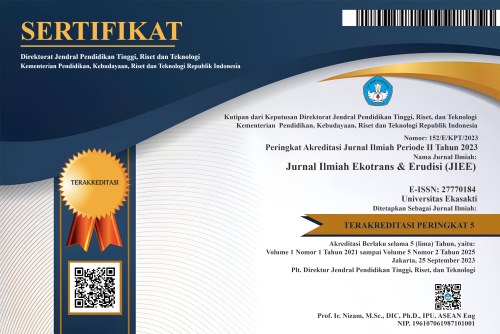
Accreditation and Certificate

Jurnal Ilmiah Ekotrans & Erudisi (JIEE) is committed to maintaining transparency, fairness, accountability, and integrity in the attribution of scholarly authorship. Authorship represents both recognition of substantial intellectual contributions and responsibility for the accuracy, originality, and integrity of published research.
This policy establishes the criteria for determining authorship, identifying individual contributions, assigning author responsibilities, managing changes in authorship, and resolving authorship-related concerns. It applies to all manuscripts submitted to JIEE, regardless of research methodology, disciplinary orientation, institutional affiliation, or number of contributors.
The journal's authorship principles are informed by the recommendations of the International Committee of Medical Journal Editors (ICMJE), the ethical guidance of the Committee on Publication Ethics (COPE), and the Contributor Roles Taxonomy (CRediT) established under ANSI/NISO Z39.104-2022.
Authorship must be based on genuine and substantial scholarly contributions rather than academic rank, administrative authority, institutional position, financial support, or personal relationships.
All individuals who satisfy the journal's authorship criteria should receive appropriate recognition as authors. Conversely, individuals who do not meet these criteria should not be included in the author list solely because of their seniority, supervisory responsibilities, institutional affiliations, or other non-intellectual considerations.
Each author must understand the significance of authorship and accept responsibility for the integrity of the submitted work. The identification and order of authors should be determined collectively by the research team before manuscript submission.
JIEE adopts four cumulative authorship criteria adapted from the ICMJE recommendations. To qualify as an author, an individual must satisfy all four criteria:
All four conditions must be fulfilled. Individuals who make substantial contributions to the research should be given a reasonable opportunity to participate in manuscript development, critical revision, and final approval.
Authors are collectively responsible for ensuring that all eligible contributors are appropriately recognized and that no ineligible individuals are included in the authorship list.
To promote transparency in scholarly contributions, JIEE encourages authors to provide an Author Contributions Statement describing each author's role in the research and manuscript preparation.
Contributions should be identified using the Contributor Roles Taxonomy (CRediT), which recognizes the following fourteen roles:
One author may perform several roles, and multiple authors may share the same role. However, assignment of a CRediT role does not automatically establish eligibility for authorship. Individuals must still satisfy the journal's authorship criteria.
Example of an Author Contributions Statement:
Author A: Conceptualization, methodology, formal analysis, and writing – original draft. Author B: Investigation, data curation, and writing – review & editing. Author C: Validation, visualization, supervision, and writing – review & editing. All authors reviewed and approved the final manuscript and agreed to be accountable for its content.
The corresponding author is responsible for ensuring that the contributions are accurately described and approved by all authors.
The corresponding author serves as the primary contact between the authors and the journal throughout the submission, peer review, publication, and post-publication processes.
The corresponding author's responsibilities include:
The corresponding author does not have exclusive authority to make substantive changes to the manuscript, author list, or research conclusions without the knowledge and agreement of the other authors.
The order of authors must reflect an agreement among all contributors who qualify for authorship. JIEE recognizes that disciplinary conventions and collaborative research arrangements may influence authorship order.
The first author is ordinarily the researcher who has assumed a leading role in the intellectual development and preparation of the manuscript. However, authorship order must be determined through transparent agreement among the authors rather than imposed solely on the basis of institutional hierarchy or academic seniority.
Where two or more authors have contributed equally, an equal-contribution statement may be included, subject to editorial verification and the journal's publication format.
Any disagreement concerning authorship order should be resolved by the authors before submission. The editorial team does not determine authorship order on behalf of the research team.
Individuals who contribute to a research project but do not satisfy all authorship criteria should receive appropriate acknowledgment rather than authorship credit.
Contributions that do not independently justify authorship include:
Such contributions may be recognized in an Acknowledgments section. The corresponding author should obtain permission from individuals who are specifically identified in the acknowledgments.
Research collaborators, including local researchers and field partners, must be evaluated fairly against the same authorship criteria. Eligible contributors must not be excluded because of their institutional affiliation, nationality, academic status, or geographical location.
JIEE does not permit inappropriate attribution or manipulation of scholarly authorship.
The following practices are considered unacceptable:
Suspected authorship misconduct may result in editorial investigation, suspension of manuscript processing, rejection, or appropriate post-publication action, depending on the available evidence and stage of publication.
Authors are expected to finalize the authorship list and author order before submitting their manuscript. Changes requested after submission are considered exceptional and require a clear academic or ethical justification.
Requests to add, remove, or reorder authors after initial submission must be submitted to the editorial team by the corresponding author.
The request must include:
The editorial team may suspend manuscript processing while an authorship concern is being clarified. The journal reserves the right to decline a proposed authorship change when adequate justification or required agreement is not provided.
Requests to change authorship after publication require careful editorial assessment and appropriate supporting documentation.
Where a change is justified and all relevant parties agree, the journal may publish a formal correction notice and update the article metadata as appropriate while preserving the integrity and transparency of the scholarly record.
Requests involving unresolved disputes or allegations of misconduct may be referred to the relevant research institution for investigation before a final editorial action is taken.
JIEE recognizes that disputes may arise concerning authorship eligibility, contribution, author order, or the exclusion of eligible contributors.
Authors should initially attempt to resolve such disagreements through transparent discussion within the research team. Where agreement cannot be reached, the dispute should be referred to the appropriate institutional authority or research integrity office.
The editorial team may request supporting documentation, suspend manuscript processing, or seek clarification from the relevant institution. However, JIEE does not independently adjudicate disputed claims of intellectual contribution when these require a formal institutional investigation.
Editorial responses to authorship disputes are informed by relevant COPE guidance and aim to protect the integrity of the scholarly record while ensuring fairness to all parties.
Artificial intelligence systems, large language models, chatbots, and other AI-assisted technologies cannot be listed as authors or co-authors of manuscripts submitted to JIEE.
Such technologies cannot independently assume responsibility for research integrity, approve a manuscript, disclose conflicts of interest, or respond to scientific concerns. Consequently, they do not satisfy the journal's authorship criteria.
Authors who use AI-assisted tools in manuscript preparation or research activities must retain full responsibility for the accuracy, originality, reliability, and ethical compliance of their work.
Substantive AI assistance must be disclosed transparently. Where AI tools are used for writing assistance, the use should be described in an appropriate disclosure or acknowledgment statement. Where AI tools materially contribute to data processing, analysis, research procedures, or figure generation, the relevant methods should be described sufficiently to support transparency and reproducibility.
Authors must verify all AI-assisted content, including quotations, citations, references, analytical interpretations, and generated materials, before submission.
Further requirements concerning the responsible use of artificial intelligence are addressed in the journal's applicable editorial and publication ethics policies.
All authors must provide accurate information about their names, institutional affiliations, and relevant academic identities at the time of submission.
Institutional affiliations should reflect the author's genuine academic or professional connection with the institution relevant to the research. Authors must not claim affiliations that are inaccurate, misleading, or unauthorized.
JIEE encourages authors to provide their ORCID iD to support accurate author identification, scholarly attribution, and the interoperability of publication metadata.
Corrections to author identification or affiliation information should be communicated to the editorial team promptly and supported by appropriate documentation when required.
By submitting a manuscript to JIEE, the corresponding author confirms, on behalf of the author group, that:
The editorial team may request individual author confirmation or supporting documentation when needed to verify compliance with this policy.
This authorship policy is informed by the following internationally recognized guidance:
Policy Implementation: This policy becomes applicable to manuscript submissions following its formal adoption and publication by the JIEE editorial management. Any subsequent amendments should be communicated transparently through the journal's official website.
Accreditation and Certificate
Main Menu
Template


Support By



Tools



PEER-REVIEWED • OPEN ACCESS
An open-access scholarly journal advancing research in public administration, governance, public policy, and the social and political sciences.
Published by the Faculty of Social and Political Sciences and LPPM, Universitas Ekasakti, Padang, Indonesia.