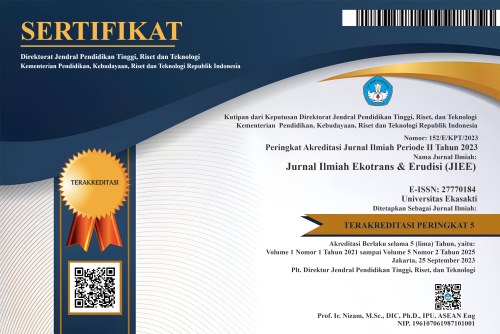
Accreditation and Certificate
Jurnal Ilmiah Ekotrans & Erudisi (JIEE) is a peer-reviewed, open-access scholarly journal committed to the free and unrestricted dissemination of scientific knowledge. The journal recognizes that equitable access to research contributes to scholarly collaboration, academic transparency, knowledge development, informed policymaking, and the advancement of public administration, governance, public policy, organizational studies, and related social sciences.
JIEE provides immediate open access to its published scholarly content and supports the responsible use, sharing, preservation, and dissemination of scientific publications in accordance with the journal's copyright and licensing arrangements.
This policy establishes the journal's principles regarding public access, reader rights, permitted reuse, copyright ownership, self-archiving, publication charges, accessibility, and the long-term availability of scholarly publications.
JIEE provides immediate, free, and open access to the full text of its published scholarly articles without a subscription fee, access embargo, or mandatory reader registration.
Readers may access, read, download, copy, print, search, link to, and share published articles for lawful purposes in accordance with the Creative Commons license applicable to each publication.
The journal's open-access model is intended to remove financial and technical barriers that unnecessarily restrict access to publicly disseminated scholarly knowledge.
JIEE supports the principle that research findings should be accessible to researchers, students, policymakers, public administrators, practitioners, and members of the public regardless of geographical location or institutional affiliation.
JIEE's open-access approach is based on the following principles:
JIEE operates under an open-access publishing model in which scholarly articles are publicly accessible through the journal's official Open Journal Systems (OJS) platform.
Articles accepted following editorial assessment and peer review are published online and made available through their respective article landing pages.
The journal does not require readers to purchase individual articles, obtain institutional subscriptions, or register for an account solely to access published full-text research.
Manuscript submission and editorial processing are separate from reader access. Registration may be required for authors, reviewers, or editors performing functions within the OJS publishing system, but not for ordinary public access to published articles.
JIEE publishes scholarly articles under the Creative Commons Attribution-ShareAlike 4.0 International License (CC BY-SA 4.0), as stated in the journal's published copyright and licensing information.
Under this license, users may share and adapt licensed material, including for commercial purposes, subject to the conditions established by Creative Commons.
The principal conditions require users to provide appropriate attribution, link to the applicable license, indicate relevant modifications, and distribute adapted material under the same or an approved compatible ShareAlike license when the adaptation is shared.
Users must not impose additional legal or technological restrictions that prevent others from exercising the rights granted by the applicable Creative Commons license.
The official license terms are available at:
Creative Commons Attribution-ShareAlike 4.0 International (CC BY-SA 4.0).
Copyright and licensing arrangements applicable to individual articles should be identified in the article metadata and publication files. Any specific third-party materials excluded from the article's Creative Commons license must be clearly identified.
Subject to the applicable license and the rights associated with specific materials, readers are permitted to:
Users must respect relevant third-party rights, privacy protections, applicable legal requirements, and any material expressly excluded from the article's open license.
Authors publishing in JIEE retain the copyright to their scholarly works and grant the journal the right of first publication under the agreed publishing terms.
Authors may enter into separate non-exclusive arrangements for further distribution of the published work, provided that the original publication in JIEE is appropriately acknowledged and the arrangements do not conflict with the applicable public license.
Authors are encouraged to disseminate their published research through institutional repositories, disciplinary repositories, personal academic websites, and legitimate scholarly communication platforms.
The journal does not claim an exclusive copyright transfer merely because an article is accepted or published.
Additional information is provided in the journal's Copyright Notice.
JIEE supports author self-archiving as a means of increasing the visibility, discoverability, accessibility, and long-term dissemination of scholarly research.
Subject to the rights applicable to the relevant manuscript and any third-party content, authors may deposit the following versions of their work:
Deposits may be made in institutional repositories, disciplinary repositories, university research information systems, or personal academic websites, subject to applicable copyright and ethical requirements.
Authors should include an appropriate citation to the published article and its DOI where available.
Self-archiving of the Version of Record should preserve the copyright statement, applicable Creative Commons license, attribution details, and acknowledgment of JIEE as the original journal of publication.
Depositing an article in a repository must not misrepresent its peer review status or publication history.
Further information is available in the journal's Archiving Policy.
Open access refers to the accessibility and permitted reuse of published scholarly content. It does not necessarily mean that manuscript publication is free of all author-side charges.
Where the journal applies an Article Processing Charge or other publication-related fee, the applicable amount, payment requirements, and waiver arrangements must be disclosed separately and transparently.
Any author-side publication charges must not affect the independence of manuscript evaluation or the final scientific editorial decision.
Readers must not be charged for access to published open-access articles merely because the journal applies a publication fee to accepted manuscripts.
For current information concerning publication fees, please consult the Article Processing Charge policy.
JIEE maintains a clear distinction between open-access distribution, financial administration, and academic editorial assessment.
Manuscript acceptance must be based on scholarly relevance, originality, methodological rigor, analytical quality, ethical compliance, and the journal's editorial standards.
Neither payment of publication charges nor the availability of financial support guarantees manuscript acceptance.
All manuscripts considered for publication must satisfy the journal's established editorial and peer review requirements.
Open-access publication does not eliminate the responsibility of editors, reviewers, or authors to protect the reliability and integrity of the scholarly record.
JIEE supports the discoverability of published research through appropriate publication metadata, persistent article identifiers, bibliographic information, and indexing arrangements.
Published articles should provide accurate information concerning article titles, authors, institutional affiliations, abstracts, keywords, publication dates, and DOI identifiers where assigned.
The journal encourages lawful discovery, indexing, and linking of its openly licensed scholarly content by academic search engines, bibliographic databases, libraries, repositories, and research information services.
Indexing or discoverability does not automatically indicate endorsement by an indexing organization or establish that the journal has obtained a particular accreditation or indexing status.
Statements concerning indexing and accreditation must reflect verifiable, current information.
Long-term accessibility is an important component of responsible open-access publishing.
JIEE supports appropriate measures to maintain the accessibility, reliability, and preservation of published scholarly content.
Such measures may involve institutional digital infrastructure, electronic backups, repository deposits, distributed preservation arrangements, and other technically and institutionally supported archiving mechanisms.
Specific preservation services must be identified accurately. The journal should not claim participation in a preservation network unless the relevant arrangement has been established and can be documented.
Detailed information about digital preservation and author self-archiving is provided in the journal's Archiving Policy.
Open-access publication does not automatically remove restrictions applicable to third-party copyright, confidential records, private information, protected research data, or other materials that are not lawfully covered by the article's Creative Commons license.
Authors are responsible for identifying materials requiring separate authorization and for obtaining permission where necessary.
Third-party materials not included under the CC BY-SA 4.0 license should be clearly marked with the relevant copyright or permission information.
Users must respect such limitations and must not assume that every item reproduced within an article is necessarily licensed under the same terms.
Public access to research findings must also be balanced with applicable research ethics, participant confidentiality, and data protection obligations.
JIEE recognizes that openly available articles may require corrections, clarifications, expressions of concern, or retractions when significant issues are identified after publication.
The journal is committed to maintaining transparent links between original publications and subsequent editorial notices.
Corrections and retraction notices should remain publicly accessible so that readers can identify the current status of the relevant scholarly work.
Open access does not justify the silent removal of substantive publication information or the undisclosed replacement of published research findings.
Post-publication actions must follow the journal's applicable publication ethics and correction procedures.
This Open Access Policy should be read together with the following JIEE policies:
The journal's copyright, licensing, and self-archiving provisions should be interpreted consistently. Where different versions of a publication are subject to different rights or permissions, the applicable conditions must be identified accurately.
This Open Access Policy establishes the journal's framework for immediate public access, transparent reuse rights, author copyright retention, and responsible dissemination of scholarly publications.
The revised policy becomes effective following formal approval and publication by the responsible JIEE editorial management.
The journal should periodically review this policy to maintain consistency with its Copyright Notice, Licensing Policy, Archiving Policy, Article Processing Charge Policy, and applicable international publishing standards.
Material changes must be communicated transparently through the official journal website and must not misrepresent the licensing conditions applicable to previously published articles.
Accreditation and Certificate
Template

Support By


Tools