Accreditation and Certificate
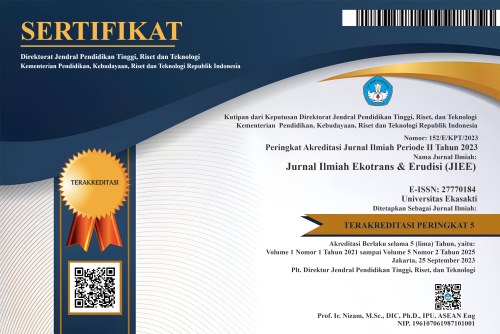

Jurnal Ilmiah Ekotrans & Erudisi (JIEE) is committed to maintaining the accessibility, integrity, reliability, discoverability, and continuity of its published scholarly content. The journal recognizes that responsible scholarly publishing requires appropriate arrangements for digital archiving, operational data backup, recovery of publication records, and the long-term availability of scientific knowledge.
JIEE is published under the institutional auspices of Universitas Ekasakti, Indonesia, through the Faculty of Social and Political Sciences in collaboration with the Institute for Research and Community Service (LPPM). The journal uses the Open Journal Systems (OJS) platform to manage and disseminate its scholarly publications.
JIEE's current digital archiving arrangements consist of maintaining published content through its official OJS platform, performing operational backups of the OJS database and article files through the university's cPanel-based hosting infrastructure, and permitting authors to archive their scholarly works in appropriate repositories.
The journal distinguishes these arrangements from independent, distributed long-term digital preservation. JIEE does not currently use the Public Knowledge Project Preservation Network (PKP PN) and does not claim participation in another external preservation service without verified evidence of active participation and content preservation.
This policy establishes the principles, responsibilities, and procedures governing digital archiving, backup and recovery, repository deposits, manuscript version management, copyright and licensing, publication metadata, and continuity of access to the scholarly record.
The primary objective of this policy is to establish a transparent and responsible framework for managing and safeguarding JIEE's scholarly publications and associated digital records.
The specific objectives are to:
JIEE's digital archiving framework covers materials associated with its scholarly publishing activities, subject to applicable access permissions and retention requirements.
Publicly available scholarly materials include:
Administrative records may include manuscript submissions, editorial decisions, peer review documentation, and related correspondence. These records must be managed separately from publicly accessible scholarly content and remain subject to appropriate confidentiality and access controls.
JIEE maintains its scholarly publishing records through the following arrangements:
Published articles, journal issues, and associated metadata are maintained through the official JIEE website using Open Journal Systems.
The OJS platform supports the organization and public dissemination of scholarly publications and provides article landing pages containing bibliographic information and links to available full-text files.
This journal-based archive serves as the primary public access point for published JIEE content.
Official Journal Website: https://journal.unespadang.ac.id/JIEE/
JIEE performs operational backups of its OJS database and article files through the cPanel-based hosting infrastructure of Universitas Ekasakti.
These backups support the recovery of relevant publication information and digital article files in the event of accidental deletion, database corruption, technical malfunction, or other incidents affecting the journal's publishing environment.
The backup arrangements are administered through the university's hosting environment by personnel with appropriate technical authorization.
The journal recognizes the importance of maintaining recoverable copies of its essential publication records. Backup frequency, retention periods, storage arrangements, and recovery procedures are determined by the actual technical configuration and institutional hosting practices.
The journal does not claim a specific automated backup frequency, independent off-site backup location, or completed restoration testing unless those arrangements have been implemented and verified.
JIEE permits authors to preserve and disseminate permitted manuscript versions through institutional repositories, subject repositories, academic websites, and other appropriate scholarly communication platforms.
This author self-archiving arrangement provides additional opportunities for access and dissemination beyond the journal's primary publishing website.
Repository deposits must comply with applicable copyright, licensing, research ethics, and confidentiality requirements.
Operational backup is an important mechanism for protecting the digital information required to maintain the journal's publishing activities.
JIEE's current backup environment is based on the university's cPanel hosting infrastructure.
The OJS database contains information necessary for the administration and presentation of journal publications.
Such information may include journal configuration data, article metadata, issue records, author information, editorial records, publication status, and other information managed by the OJS application.
Database backups are maintained through the authorized university hosting environment.
Access to database backup files should be restricted to appropriately authorized personnel because these files may contain confidential manuscript information, personal data, and editorial records.
JIEE also maintains backups of digital article files through the university's cPanel hosting infrastructure.
Publication files may include final article PDFs and other files necessary for presenting the journal's published scholarly content.
Backup arrangements should account for the relevant OJS publication file storage locations and distinguish public website assets from files stored in protected application directories.
Restoration procedures should ensure that database information and corresponding publication files are sufficiently consistent to support the proper functioning of the journal website.
Effective backup management requires verification that the relevant files are complete and can support recovery when needed.
The responsible technical personnel should periodically assess the availability, integrity, and recoverability of backup copies according to applicable institutional procedures.
Backup verification may include examination of database exports, confirmation of publication file coverage, identification of incomplete backup archives, and evaluation of available restoration procedures.
Where verification or restoration testing is performed, the results should be documented appropriately.
In the event of technical disruption, the journal management should coordinate with authorized university hosting personnel to evaluate the incident and determine the appropriate restoration procedure.
Recovery activities should prioritize the integrity of the publication database, availability of published article files, accuracy of article metadata, and restoration of access to the journal's website.
Restoration must be carried out through authorized technical procedures designed to minimize further data loss or unintended changes to publication records.
The journal should maintain appropriate documentation of significant recovery incidents and any corrective measures implemented.
JIEE explicitly distinguishes operational backup from independent long-term digital preservation.
Operational backup involves maintaining recoverable copies of system data and files to support restoration after technical failure, accidental deletion, or other operational incidents.
Long-term digital preservation involves arrangements intended to protect the continued usability and accessibility of scholarly content over extended periods, including circumstances in which the original publisher or hosting environment is no longer available.
The availability of archived articles on the OJS website and the existence of cPanel backups do not independently establish participation in a recognized, distributed long-term preservation service.
JIEE does not currently use PKP PN. The journal will not report participation in LOCKSS, CLOCKSS, Portico, or another external preservation service unless the relevant participation and actual preservation of content can be verified.
JIEE recognizes the value of developing additional independent preservation arrangements as part of its future institutional quality improvement activities.
Any newly implemented preservation service should be identified accurately and supported by appropriate evidence of configuration, content deposit, and operational status before being added to this policy.
JIEE supports the principles of open scholarly communication and permits authors to archive appropriate versions of their research in institutional, disciplinary, and other lawful repositories.
Author self-archiving is intended to increase research accessibility, improve dissemination, and provide additional opportunities for scholarly discovery.
The journal recognizes three principal manuscript versions.
A Preprint is a manuscript version that has not completed the journal's formal peer review and acceptance processes.
Authors may deposit preprints in appropriate repositories or academic websites before, during, or after manuscript submission, subject to applicable ethical, copyright, and third-party rights.
Deposited preprints must not be represented as peer-reviewed or formally accepted JIEE publications.
When the manuscript is subsequently published, authors are encouraged to update the preprint record with the final journal citation and DOI.
An Author Accepted Manuscript (AAM) is the version accepted for publication after completion of the applicable peer review and editorial revision processes but before final journal production and formatting.
Authors may deposit the accepted manuscript in institutional repositories, disciplinary repositories, or other appropriate scholarly platforms without a journal-imposed embargo.
The deposited version should be identified accurately as the accepted manuscript and linked to the published Version of Record when available.
The Version of Record (VoR) is the final official version of an article published by JIEE, including the authoritative publication information.
Authors may deposit, share, and distribute the Version of Record in accordance with the applicable Creative Commons license.
Repository deposits should retain the original article citation, author attribution, copyright statement, licensing information, and DOI or permanent publication link.
Where the published article is subsequently corrected or retracted, repository records should be updated to reflect the relevant publication status.
JIEE does not impose a journal-level embargo on the deposit of permitted manuscript versions.
Authors may archive preprints, accepted manuscripts, and published Versions of Record in appropriate repositories, subject to the rights and ethical requirements applicable to each version.
The absence of a journal-imposed embargo does not override third-party copyright, confidentiality obligations, participant privacy, contractual restrictions lawfully applicable to particular materials, or other legal requirements.
Authors are responsible for ensuring that deposited materials may lawfully be made publicly accessible.
JIEE permits the lawful deposit of scholarly manuscripts and publications through appropriate platforms, including:
Authors must ensure that repository deposits are consistent with the applicable rights and the platform's terms of service.
Publication in an external repository does not transfer editorial responsibility for the original article away from JIEE.
Third-party repositories must not be represented as formal long-term preservation partners of the journal unless an appropriate institutional arrangement has been established.
Authors who archive their work should provide sufficient bibliographic information to identify the original publication.
Recommended information includes:
Authors should distinguish clearly between a submitted manuscript, an accepted manuscript, and the formally published Version of Record.
Repository records must not contain misleading information concerning manuscript acceptance, peer review completion, or publication status.
JIEE recognizes the copyright ownership of authors and supports appropriate reuse of scholarly publications through transparent open-access licensing.
Under the journal's published Copyright Notice, authors retain copyright and grant JIEE the right of first publication.
Articles published under the journal's stated licensing arrangement are distributed under the Creative Commons Attribution-ShareAlike 4.0 International License (CC BY-SA 4.0).
This license permits copying, sharing, redistribution, translation, and adaptation, including commercial reuse, subject to appropriate attribution and the applicable ShareAlike conditions.
Archived copies must retain relevant copyright and licensing information.
Third-party materials that are expressly excluded from the article's Creative Commons license remain subject to their respective copyright and permission requirements.
The Creative Commons license applied to the published Version of Record does not automatically determine the rights applicable to all unpublished manuscript versions or independently licensed third-party materials.
Further information is available in the JIEE Copyright Notice and the official CC BY-SA 4.0 License.
Accurate bibliographic metadata is essential for the identification, discovery, citation, and continued accessibility of published scholarly research.
JIEE maintains publication information through its OJS platform, including article titles, author information, abstracts, keywords, issue details, and relevant publication identifiers.
The journal uses Digital Object Identifiers (DOIs) to support persistent identification of scholarly articles.
DOI registration supports persistent identification and linking but does not, by itself, constitute independent long-term preservation of article content.
When journal URLs or publication locations change, the responsible management should take appropriate steps to update DOI registration information and maintain the accuracy of persistent links.
When significant post-publication changes occur, the journal should maintain appropriate relationships between the original publication and any formal correction or retraction notice.
Metadata backups and relevant exports should be maintained consistently with the capabilities of the OJS system and the university's technical infrastructure.
JIEE recognizes the importance of maintaining the completeness, usability, and integrity of its published digital files.
Article files should be stored and maintained using appropriate formats that support access and scholarly use.
Where technically feasible, file integrity management may include:
The journal should not replace a published article with a substantively different file without appropriate editorial authorization and documentation.
Technical changes must preserve the scholarly meaning, research findings, authorship information, and publication history of the work.
JIEE recognizes that corrections, expressions of concern, retractions, and other post-publication notices form part of the scholarly record.
These notices should remain accessible and appropriately linked to the original articles.
Where an article is corrected, the journal should provide sufficient information to identify the original publication and the nature of the correction.
Where an article is retracted, the original article should ordinarily remain identifiable with a clear indication of its retracted status, unless exceptional legal, privacy, or safety circumstances require otherwise.
Substantive editorial changes must not be concealed through silent replacement or deletion of publication files.
Where correction or retraction notices are included in the journal's digital records, the associated backup arrangements should preserve the available publication files and relevant metadata.
Detailed procedures are governed by the journal's Publication Ethics and Correction and Retraction policies.
JIEE recognizes that the OJS database and its operational backups may contain confidential editorial information and personal data.
Such information may include manuscript submissions, author contact information, peer review communications, editorial decisions, and other non-public records.
Access to hosting accounts, database backups, publication file directories, and administrative recovery functions should be limited to appropriately authorized personnel.
Backup and recovery procedures should protect confidential information from unauthorized disclosure, alteration, loss, or misuse.
Digital archiving and backup activities must comply with applicable institutional information security requirements and relevant privacy obligations.
The existence of backup copies must not be used as justification for publicly disclosing confidential manuscripts, reviewer identities, or other protected information.
JIEE recognizes that the availability of published articles may be affected by server outages, hosting problems, domain changes, application failures, cybersecurity incidents, or institutional disruptions.
The journal's continuity arrangements rely on coordination between the editorial management and authorized personnel responsible for the university's hosting infrastructure.
Where a significant disruption occurs, reasonable efforts should be made to:
The journal does not guarantee uninterrupted service or recovery within a specific time unless such a service commitment has been formally established and supported by the relevant institutional infrastructure.
JIEE recognizes that changes in publishing institutions, technological platforms, or organizational arrangements may affect the continued availability of previously published articles.
If the journal migrates to a different publishing platform or hosting environment, the responsible management should make reasonable efforts to preserve its existing publication files, article metadata, issue information, copyright and licensing records, and DOI relationships.
Where possible, migration procedures should preserve the relationship between the previous publication records and their new locations.
In the event of permanent journal closure, the institutional publisher should consider appropriate arrangements for maintaining lawful access to the existing scholarly record through available institutional or other suitable systems.
Such arrangements may include continued institutional hosting, transfer to an authorized repository, or another properly established preservation arrangement.
JIEE does not guarantee continued availability through an independent third-party preservation service unless such an arrangement has actually been implemented and confirmed.
The effective implementation of this policy requires coordination among the institutional publisher, editorial management, and authorized technical personnel.
Universitas Ekasakti provides the institutional context for the journal's publishing activities and the university hosting infrastructure used for operational backups.
The responsible institutional units support appropriate coordination concerning the sustainability and continuity of journal publishing services.
The Editor-in-Chief provides editorial oversight concerning the accuracy and integrity of the published scholarly record, including significant corrections and other formal editorial actions.
The Managing Editor coordinates the administrative management of publication records, issue information, article metadata, and communication with authorized technical personnel concerning digital archiving matters.
Authorized personnel responsible for the university's hosting environment administer the applicable cPanel-based backup arrangements and support relevant technical recovery procedures within their assigned authority.
The specific allocation of technical responsibilities, backup schedules, retention practices, and restoration procedures should be determined through the university's actual operational arrangements.
JIEE recognizes that the reliability of its digital archiving arrangements depends on appropriate operational monitoring and documented implementation.
The responsible personnel should periodically review:
Monitoring should be supported by appropriate administrative or technical documentation.
The journal should distinguish clearly between arrangements that are operational, arrangements that have been verified through testing, and improvements that remain under consideration.
JIEE is committed to accurately communicating the status of its digital archiving and preservation arrangements.
The journal currently uses OJS for publication access and cPanel-based university hosting for operational backups of its database and article files.
JIEE does not currently use PKP PN. No other independent long-term preservation service is represented as active under this policy without appropriate verification.
The journal acknowledges that operational backups and author repository deposits complement, but do not fully replace, independent long-term preservation arrangements.
As part of its continuing institutional quality improvement, JIEE may evaluate additional preservation mechanisms intended to strengthen the long-term resilience of its scholarly publication record.
Any future implementation of an external preservation service should be supported by formal authorization, appropriate technical configuration, successful preservation activities, and verifiable supporting documentation.
The journal's public Archiving Policy should be updated when a material change in the actual preservation arrangements occurs.
This Archiving Policy and Digital Preservation Policy is intended to operate consistently with the journal's editorial, publication ethics, open-access, and copyright arrangements.
Related journal policies include:
Requirements concerning copyright ownership, Creative Commons licensing, author self-archiving, corrections, retractions, research ethics, and publication metadata must remain consistent across the journal's policies.
This policy is informed by internationally recognized guidance concerning scholarly archiving, repository permissions, publishing transparency, and digital record management.
This Archiving Policy and Digital Preservation Policy establishes JIEE's framework for maintaining its published scholarly records through journal-based digital archiving, university-hosted operational backups, and author self-archiving permissions.
The policy reflects the journal's current use of the OJS platform and cPanel-based university hosting for backups of the OJS database and article files.
The revised policy becomes effective following formal approval and publication by the responsible JIEE editorial management.
The policy should be reviewed periodically to maintain consistency with actual hosting arrangements, backup and recovery practices, copyright and licensing requirements, publication technologies, and developments in long-term scholarly preservation.
Significant changes should be documented and communicated transparently through the journal's official website.
JIEE is committed to preserving the accessibility and integrity of its scholarly publications through accurate documentation, responsible operational archiving, and the continued development of appropriate digital preservation practices.
Accreditation and Certificate
Template


Support By



Tools