Accreditation and Certificate
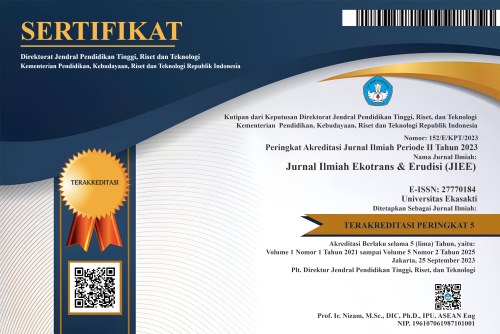

Jurnal Ilmiah Ekotrans & Erudisi (JIEE) welcomes original, theoretically informed, methodologically rigorous, and ethically responsible scholarly manuscripts that contribute to the advancement of knowledge in public administration, governance, public policy, organizational and management studies, and related social and political sciences.
Authors are required to prepare and submit manuscripts in accordance with these Author Guidelines, the journal's official manuscript template, its objectives and scope, and all applicable editorial and publication ethics policies.
Manuscripts that do not comply with essential submission requirements may be returned for correction or declined during the initial editorial screening. Compliance with formatting requirements does not guarantee acceptance for peer review or publication.
JIEE is committed to transparent editorial processes, independent double-blind peer review, responsible research reporting, and the dissemination of high-quality scholarly contributions.
Submitted manuscripts must establish a meaningful relationship with the journal's scholarly objectives and disciplinary scope.
JIEE primarily publishes research concerning:
Interdisciplinary research is welcomed when the manuscript clearly demonstrates its contribution to governance, administration, organizational studies, public policy, or closely related social science scholarship.
Manuscripts should move beyond the description of administrative or organizational phenomena by developing a clear research problem, critically engaging with relevant literature, and presenting a meaningful theoretical, empirical, methodological, or policy-related contribution.
Detailed disciplinary coverage is available in the Objectives and Scope.
JIEE receives scholarly manuscripts through the Articles submission section of its Open Journal Systems platform. Under the journal's approved manuscript classification framework, eligible contributions may be identified by their principal scholarly approach.
Original Research Articles report new empirical investigations conducted through appropriate qualitative, quantitative, mixed-methods, comparative, longitudinal, or evaluative research designs.
These manuscripts must present original findings supported by transparent methods, credible evidence, and rigorous analysis.
Review Articles systematically or critically synthesize existing scholarly knowledge to develop new insights, identify unresolved research questions, evaluate competing explanations, or advance theoretical and methodological understanding.
Appropriate approaches may include systematic literature reviews, scoping reviews, meta-analyses, integrative reviews, and analytically rigorous bibliometric reviews.
Review manuscripts must demonstrate methodological transparency and provide substantive synthesis rather than merely presenting descriptive literature summaries.
Conceptual and Theoretical Articles develop, refine, integrate, or critically evaluate concepts, theories, propositions, typologies, or analytical frameworks relevant to the journal's scope.
These manuscripts must provide original theoretical reasoning and a clearly articulated contribution grounded in credible scholarly literature.
Policy and Governance Analysis Articles systematically examine policy processes, institutional arrangements, governance mechanisms, administrative performance, or policy outcomes.
They must present an explicit analytical framework, credible evidence, and conclusions that contribute to policy or governance scholarship.
The manuscript classification must accurately reflect the research design and scholarly contribution. Authors should not misrepresent descriptive reports, policy opinions, or unsystematic literature summaries as original research or systematic scholarly reviews.
Manuscripts must be prepared in English.
Authors are responsible for ensuring that the manuscript is written in clear, accurate, coherent, and grammatically appropriate academic English.
Either American or British English may be used, provided that spelling, terminology, punctuation, and academic conventions remain consistent throughout the manuscript.
Technical terminology must be used accurately and consistently. Abbreviations should be defined at their first occurrence unless universally recognized within the relevant discipline.
Manuscripts containing substantial language problems that prevent meaningful scientific assessment may be returned for revision before peer review.
Authors may use professional language editing or appropriate language-assistance tools, but remain fully responsible for the accuracy, meaning, originality, and integrity of the final manuscript.
All manuscripts must be prepared using the official JIEE manuscript template and submitted in an editable Microsoft Word format (.doc or .docx).
The journal's formatting requirements are as follows:
| Component | Requirement |
|---|---|
| Document format | Microsoft Word (.doc or .docx) |
| Page size | A4 |
| Margins | 2.5 cm on all sides |
| Main font | Palatino Linotype |
| Main text size | 10 pt |
| Line spacing | Single |
| Article title | Palatino Linotype, 20 pt, bold |
| Abstract | Palatino Linotype, 8 pt, italic, single paragraph |
| Keywords | Palatino Linotype, 8 pt |
| References | Palatino Linotype, 11 pt, single spacing, hanging indent |
| Manuscript length | 4,000–8,000 words, including the abstract, references, and footnotes |
| Abstract length | 100–200 words |
| Keywords | Maximum of five keywords or key phrases |
| Reference style | American Psychological Association (APA) |
Authors must follow the formatting instructions provided in the current official journal template, including requirements for headings, paragraphs, tables, figures, citations, and references.
Official JIEE Manuscript Template: Download the JIEE Manuscript Template.
Authors should use the template as the basis for manuscript preparation and avoid unnecessary modifications to its document structure and formatting.
The manuscript must remain editable so that authors can implement revisions and the editorial team can perform appropriate production processing.
Manuscripts should contain between 4,000 and 8,000 words, including the abstract, references, and footnotes.
Authors should ensure that the manuscript contains sufficient methodological detail, theoretical engagement, evidence, and critical discussion within the prescribed length.
Manuscripts that substantially exceed or fall below the prescribed range may be returned for revision or considered only with prior editorial authorization.
Conciseness must not be achieved by omitting essential methodological information, relevant findings, or limitations necessary for scientific evaluation.
JIEE uses a double-blind peer review system. Authors must therefore prepare an anonymized manuscript file for peer review.
The manuscript submitted for review must not contain information that directly identifies the authors.
Authors must:
Authors must enter accurate information for all contributors in the OJS system, including their names, affiliations, country information, and email addresses as required by the submission interface.
ORCID identifiers are strongly encouraged to support accurate identification and attribution of scholarly contributions.
The corresponding author must ensure that author information in OJS is complete and consistent with the approved authorship list.
Following acceptance, the editorial office will coordinate the inclusion of author details, acknowledgments, and other relevant information in the final publication file.
The manuscript title must be concise, informative, scientifically accurate, and representative of the central research question or scholarly contribution.
The title should identify the principal concepts or research phenomenon without making unsupported claims about novelty, causality, generalizability, or policy impact.
Authors should avoid unnecessary abbreviations, excessive technical terminology, ambiguous expressions, and promotional language.
The title must follow the journal's formatting requirements: Palatino Linotype, 20 pt, bold.
The same title must be entered accurately in the OJS submission metadata.
Each manuscript must include an English-language abstract of 100–200 words.
The abstract must be presented as a single paragraph, using Palatino Linotype, 8 pt, italic formatting in accordance with the journal template.
The abstract must be self-contained and should not include citations, unexplained abbreviations, unsupported conclusions, or detailed references to tables and figures.
For Original Research Articles, the abstract should summarize:
For Review Articles, the abstract should explain the review objective, evidence selection or review methodology, major synthesis findings, and contribution to the literature.
For Conceptual and Theoretical Articles, the abstract should identify the theoretical problem, analytical approach, principal argument, and original conceptual contribution.
For Policy and Governance Analysis Articles, the abstract should identify the relevant policy or governance problem, analytical approach, evidence, principal results, and implications.
Abstract statements must accurately reflect the information presented in the full manuscript.
Each manuscript must provide no more than five keywords or key phrases.
Keywords should identify the central concepts, theoretical focus, research methods where relevant, or substantive research context.
Authors should avoid overly general expressions, unnecessarily repeated title terms, and vague or ambiguous terminology.
Keywords must be arranged alphabetically and separated by semicolons (;).
Relevant terminology should be selected to improve scholarly indexing, information retrieval, and article discoverability.
Original Research Articles should follow a coherent structure suitable for the research design employed.
The standard structure is:
The Results and Discussion sections may be combined when doing so improves the coherence of the presentation and is appropriate for the research design.
Authors must not omit essential methodological or analytical information solely to preserve a rigid heading structure.
The Introduction must establish the research problem, explain its scholarly significance, and position the study within relevant academic debates.
An effective Introduction should:
The Introduction should not consist solely of general background information, descriptive statistics, or statements that a topic is important.
Authors must demonstrate what remains insufficiently explained by existing scholarship and how the study addresses that limitation.
The literature review must provide a critical, integrated examination of relevant research rather than a sequence of unrelated article summaries.
Authors should identify established findings, conceptual differences, methodological limitations, inconsistent evidence, and unresolved scholarly questions.
Where relevant, the theoretical framework should explain the mechanisms, relationships, propositions, or hypotheses that guide the analysis.
The theoretical framework must be appropriate to the research problem and should be applied consistently in the interpretation of findings.
Research gaps must be supported by credible examination of previous studies rather than unsupported declarations that no earlier research exists.
The Research Methods section must explain how the investigation was designed and conducted in sufficient detail to permit informed assessment of its appropriateness, transparency, and reliability.
Authors should report, as relevant:
Quantitative Studies: Authors should explain measurement and operational definitions, sampling, statistical analysis, relevant diagnostic procedures, and the reporting of meaningful estimates and uncertainty where appropriate.
Qualitative Studies: Authors should describe case or participant selection, data collection, analytical procedures, coding or interpretation methods, reflexivity where relevant, and procedures supporting credibility and trustworthiness.
Mixed-Methods Studies: Authors should explain the quantitative and qualitative components, the rationale for integration, the sequence or relationship between components, and how integration contributes to answering the research questions.
Comparative Studies: Authors should explain the basis of case selection, dimensions of comparison, evidence sources, and procedures used to support credible cross-case interpretation.
Policy Evaluation Studies: Authors should identify the intervention or policy examined, evaluation criteria, analytical framework, data sources, and limitations affecting causal or evaluative conclusions.
Methods must reflect procedures actually undertaken. Authors must not report fabricated fieldwork, fictitious respondents, unperformed analyses, or research instruments that were not used.
The Results or Findings section must present relevant empirical evidence systematically and accurately.
Findings should be organized around the research questions, objectives, hypotheses, or analytical dimensions.
Authors must distinguish observed evidence from theoretical interpretation and avoid claiming that findings demonstrate relationships or mechanisms not supported by the research design.
Tables and figures should complement the text rather than reproduce identical information unnecessarily.
Statistical results, interview evidence, documentary material, and other findings must be reported with sufficient clarity to support scholarly assessment.
The Discussion must interpret the findings critically in relation to the research problem, theoretical framework, and relevant scholarly literature.
Authors should explain:
The Discussion must move beyond repeating results and should demonstrate analytical depth and theoretical engagement.
Policy and practical implications must follow logically from the evidence and must account for relevant institutional conditions and research limitations.
The Conclusion should provide a concise synthesis of the study's principal findings and answer the stated research objectives or questions.
In accordance with the journal's established template, the conclusion should ordinarily be presented as one coherent paragraph.
The conclusion should identify the study's principal scholarly contribution and, where appropriate, its policy or practical implications and major limitations.
Authors must not introduce unsupported findings or make claims that extend beyond the evidence presented.
Review Articles must demonstrate systematic or clearly justified analytical engagement with existing scholarship.
Authors should use an appropriate reporting structure that includes:
Systematic reviews and meta-analyses should follow relevant reporting guidance, including applicable PRISMA standards.
Scoping reviews should consider relevant scoping review methodological and reporting standards, including PRISMA-ScR where appropriate.
Bibliometric manuscripts should report the database or databases used, search strings, search dates, screening and eligibility procedures, dataset preparation, analytical software, and methods used to interpret bibliometric results.
Authors must justify important methodological choices, including the use of a single bibliographic database when relevant.
Review Articles must make a substantive contribution through critical synthesis, conceptual development, explanatory interpretation, or identification of meaningful research gaps.
Descriptive publication counts, keyword frequencies, citation rankings, or visualization maps alone are not sufficient evidence of an original scholarly contribution.
Conceptual and Theoretical Articles should develop clear, logically justified, and original scholarly arguments.
Recommended components include:
Conceptual articles must demonstrate how the proposed framework or theoretical argument advances existing scholarship.
The originality of the contribution must arise from substantive theoretical reasoning rather than merely renaming existing concepts or combining familiar variables without adequate justification.
Policy and Governance Analysis Articles should systematically examine public policies, governance arrangements, institutional practices, or related administrative problems.
Recommended components include:
Recommendations must be supported by the analysis and should consider relevant implementation constraints, institutional responsibilities, and limitations of the evidence.
Purely descriptive legal summaries, administrative reports, and policy opinions without a systematic scholarly argument may be considered unsuitable for publication.
All tables and figures must be relevant, accurately labeled, and appropriately referenced in the manuscript text.
Authors must:
Tables and figures should ordinarily be placed near their first relevant discussion in accordance with the journal template.
Supplementary materials may be submitted where they materially support methodological transparency, data interpretation, or the completeness of the research.
Authors must clearly identify supplementary files and confirm that they are appropriate for publication and do not contain unauthorized confidential or personal information.
All in-text citations and reference list entries must follow the American Psychological Association (APA) referencing style, using the current journal-approved edition.
Authors should prepare references consistently using appropriate reference management software such as Mendeley, Zotero, EndNote, or another suitable application.
The following requirements apply:
Authors must not invent sources, fabricate DOI information, misrepresent cited findings, or use references that cannot be verified.
References should be selected on scholarly grounds and must not be included primarily to inflate personal, journal, or institutional citation metrics.
Authors remain responsible for verifying references suggested by digital tools, including AI-assisted writing systems.
All research submitted to JIEE must comply with applicable ethical, institutional, and legal requirements.
Studies involving human participants, surveys, interviews, focus groups, experiments, observations, or sensitive personal information must be conducted with appropriate ethical safeguards.
Where ethical approval is required, authors must obtain authorization from the relevant ethics committee, institutional authority, or other appropriately authorized body before conducting the research.
Manuscripts should identify the approving body and relevant authorization details where applicable and appropriate.
Where formal ethical approval is not required, authors may be asked to explain the applicable institutional or methodological basis for that determination.
Ethical approval must not be invented, backdated, or represented as having been obtained when no such authorization exists.
Where informed consent is required, participants must receive adequate information about the research and the voluntary nature of their participation.
Consent may be documented in written, electronic, or verbal form where permitted by applicable ethical and institutional requirements.
Authors must accurately report the procedures actually used.
Consent to participate in research must be distinguished from permission to publish identifiable personal information, photographs, quotations, or other sensitive materials when publication could reveal a participant's identity.
Authors are responsible for protecting participant privacy and confidential institutional information.
Manuscripts must not disclose identifiable personal or protected organizational information without an appropriate legal and ethical basis.
Where anonymization or pseudonymization is used, authors should consider whether combinations of contextual details could nevertheless permit identification.
JIEE supports responsible transparency concerning research evidence, analytical procedures, and data availability.
Authors must ensure that their reported findings are supported by authentic and appropriately documented research materials.
Where relevant, manuscripts should include a Data Availability Statement explaining whether the data supporting the findings are publicly accessible, available upon reasonable request, restricted for ethical or legal reasons, or otherwise unavailable for justified reasons.
Data availability must not override participant confidentiality, informed consent, institutional restrictions, third-party rights, or applicable legal requirements.
Authors may be requested to provide relevant supporting information during editorial assessment, subject to appropriate ethical and confidentiality safeguards.
Data Availability Statement: The data supporting the findings of this study are available in [repository name] at [persistent URL or DOI].
Data Availability Statement: The data supporting the findings of this study are available from the corresponding author upon reasonable request, subject to applicable ethical and institutional restrictions.
Data Availability Statement: The underlying research data are not publicly available because they contain confidential participant or institutional information. Access is restricted in accordance with the applicable consent arrangements and research ethics requirements.
Authors must select and adapt the statement that accurately represents their actual data management and sharing arrangements.
All authors must make genuine and substantial contributions to the scholarly work and comply with the journal's adopted authorship criteria.
All listed authors must approve the submitted manuscript and agree to its consideration for publication.
Gift authorship, guest authorship, ghost authorship, coercive authorship, and the sale or purchase of authorship positions are unacceptable.
The corresponding author must ensure the accuracy of author names, contribution information, affiliations, and the agreed authorship order.
Where an Author Contributions Statement is required, authors should identify their actual contributions using appropriate terms or the Contributor Roles Taxonomy (CRediT).
Author Contributions: Conceptualization: [Initials]; Methodology: [Initials]; Data Curation: [Initials]; Formal Analysis: [Initials]; Investigation: [Initials]; Writing – Original Draft: [Initials]; Writing – Review and Editing: [Initials]; Supervision: [Initials]. All authors have reviewed and approved the final manuscript.
Authors must include only the contribution roles that were actually performed.
Author order or contribution changes after submission must be justified and approved in accordance with the journal's authorship policy.
Authors must disclose financial and non-financial relationships that could reasonably influence, or appear to influence, the research or its interpretation.
Relevant relationships may involve research funding, employment, consultancy, institutional responsibilities, professional collaborations, personal relationships, or other competing interests.
Each manuscript must include an appropriate Conflict of Interest or Competing Interests declaration.
Conflict of Interest: The authors declare that they have no financial or non-financial competing interests relevant to the research reported in this manuscript.
Conflict of Interest: [Author initials] reports [describe the relevant financial, institutional, professional, or personal relationship]. The remaining authors declare no relevant competing interests.
Disclosure of a competing interest does not automatically disqualify a manuscript. The editorial team will assess the relevance and implications of the declared relationship.
Authors must disclose the financial support received for the research and, where relevant, the role of funders or sponsors.
Funding sources should be distinguished from author affiliations and other competing interests.
Funding: This research was supported by [official funding organization] under Grant No. [verified grant number]. The funder's role in the study was [accurate description of involvement].
Funding: This research received no external funding.
Authors must not report funding, grant numbers, or sponsor independence that cannot be substantiated.
Artificial intelligence-assisted tools may be used for legitimate scholarly support where their use complies with research integrity, transparency, confidentiality, and the journal's applicable editorial policies.
Authors remain fully responsible for the accuracy, originality, legality, and integrity of all content included in the manuscript.
Artificial intelligence systems cannot be listed as authors or co-authors.
Authors must disclose substantive AI assistance when it materially contributes to the preparation or analysis of the manuscript.
Relevant disclosure may include the identification of the tool and an explanation of its purpose and role.
Authors must independently verify AI-assisted references, quotations, statistical claims, analytical results, and other research-related information.
AI tools must not be used to fabricate research data, create fictitious participants, generate nonexistent interview transcripts, invent references, or misrepresent research procedures.
Confidential participant information, unpublished data subject to restrictions, and protected institutional materials must not be uploaded to external AI services without appropriate authorization and safeguards.
Declaration of AI-Assisted Tools: The authors used [tool name and version, where relevant] to assist with [specific permitted activity]. All AI-assisted content was reviewed and verified by the authors, who retain full responsibility for the accuracy, originality, and integrity of the manuscript.
Declaration of AI-Assisted Tools: The authors did not use generative artificial intelligence tools to produce or analyze substantive manuscript content.
Authors must select and adapt a declaration that accurately describes the assistance used.
Where AI tools are part of the research methodology itself, their application must also be described in the relevant Methods section.
Authors may acknowledge individuals, institutions, organizations, and other contributors who provided meaningful assistance but do not meet the journal's authorship criteria.
Acknowledgments may identify research assistance, technical support, administrative assistance, institutional cooperation, or other relevant contributions.
Individuals should not be acknowledged in a manner that falsely implies their endorsement of the research.
Permission should be obtained where acknowledgment identifies an individual and could reasonably imply their involvement or endorsement.
To preserve double-blind review, author-identifying acknowledgments should be removed from the anonymized manuscript and provided separately where necessary until the editorial process permits their inclusion.
Manuscripts submitted to JIEE must represent original scholarly work and must not be under simultaneous consideration by another journal.
Authors must ensure that previously published text, theories, data, figures, and other intellectual contributions are appropriately acknowledged.
The journal uses Turnitin as part of its manuscript similarity screening.
Similarity reports are evaluated by the editorial team and must not be treated as automatic proof of plagiarism or originality.
Authors must disclose relevant overlapping publications, preprints, conference papers, dissertations, working papers, or related research outputs when necessary for evaluating the manuscript's originality and publication history.
Fabrication, falsification, plagiarism, inappropriate duplication, citation manipulation, and interference with independent peer review are prohibited.
Suspected ethical violations are addressed through the journal's applicable publication ethics and research misconduct procedures.
All manuscripts must be submitted electronically through the official JIEE Open Journal Systems platform.
Submission Website: https://journal.unespadang.ac.id/JIEE/about/submissions.
Authors must create or use an existing OJS account and follow the online submission process.
Before completing submission, authors should:
The corresponding author is responsible for ensuring the completeness and accuracy of the submission and for communicating editorial decisions to the co-authors.
Submitting incomplete or inaccurate metadata may delay manuscript processing.
Before submitting a manuscript, authors must verify compliance with the following checklist.
Authors are responsible for complying with all applicable requirements. The editorial office may request corrections or supporting information before proceeding with scientific assessment.
After submission, manuscripts undergo an initial editorial screening to determine whether they meet the journal's scholarly scope, formatting requirements, originality standards, and applicable ethical requirements.
Manuscripts considered appropriate for further evaluation are processed through the journal's established double-blind peer review procedure.
Peer reviewers assess the scholarly contribution, theoretical framework, methodology, evidence, analytical rigor, clarity, and overall quality of the manuscript.
Possible editorial outcomes include:
A revision recommendation does not constitute a guarantee of publication.
The responsible editor considers the reviewer assessments, the scholarly merits of the manuscript, and the adequacy of author revisions before reaching a final decision.
Authors may be required to provide a structured response explaining how reviewer and editorial comments have been addressed.
Further information is available in the Peer Review Process.
Authors invited to revise a manuscript should address each relevant reviewer and editorial comment carefully and professionally.
A revised submission should ordinarily include:
Authors must not misrepresent changes, conceal unresolved methodological problems, or claim to have conducted analyses that were not actually performed.
Where a revision substantially changes research design, data interpretation, conclusions, or authorship, the relevant changes must be disclosed clearly.
Revised manuscripts remain subject to further editorial or reviewer assessment where necessary.
JIEE publishes scholarly work under an open-access model.
Authors retain copyright over their original contributions and grant the journal the right of first publication under the applicable publishing agreement.
Published articles are distributed under the Creative Commons Attribution-ShareAlike 4.0 International License (CC BY-SA 4.0).
This license permits sharing, reproduction, redistribution, translation, and adaptation, including commercial reuse, provided that the applicable attribution and ShareAlike requirements are satisfied.
Authors may share and deposit their published work in repositories and other appropriate platforms in accordance with applicable rights and the journal's self-archiving policy.
Authors are responsible for ensuring that materials included in their manuscripts can lawfully be published under the applicable arrangements.
Additional information is available in the Copyright Notice and Open Access Policy.
JIEE does not charge a fee for submitting a manuscript through its online submission system.
Under the journal's published Article Processing Charge policy, an accepted manuscript is subject to a publication fee of IDR 500,000.
Authors who do not have sufficient funds may request consideration for a publication fee waiver in accordance with the journal's stated arrangements.
Publication charges do not determine the scientific acceptance or rejection of manuscripts.
Authors must not interpret payment of an Article Processing Charge as a guarantee of publication.
All current payment arrangements and fee waiver information should be obtained through the journal's official Article Processing Charge page.
Authors retain responsibility for the integrity of their scholarly contributions after publication.
When a significant error, omission, or research integrity concern is identified, authors should contact the editorial office and cooperate with appropriate assessment and corrective procedures.
Depending on the nature of the issue, the journal may publish a correction, an Expression of Concern, a retraction, or another appropriate editorial notice.
Authors may participate in constructive post-publication discussions and respond to evidence-based scholarly criticism.
Post-publication correction procedures are intended to maintain the integrity of the scholarly record and must not be used to suppress legitimate scientific disagreement.
Authors should consult the relevant JIEE editorial policies before submitting their manuscripts.
Additional detailed policies concerning authorship, manuscript classification, research misconduct, conflicts of interest, post-publication discussion, licensing, digital archiving, and correction and retraction should be consulted once formally adopted and made publicly available through the journal's website.
These Author Guidelines provide an integrated framework for the preparation, submission, evaluation, revision, and publication of scholarly manuscripts in JIEE.
The revised guidelines become effective following formal approval and publication by the responsible editorial management.
Authors must follow the approved requirements applicable at the time of submission, together with any reasonable clarification or instruction issued by the editorial office.
The editorial team may periodically revise these guidelines to maintain consistency with the official manuscript template, developments in research methodology, publication ethics, open-access standards, and the journal's editorial procedures.
Substantive changes to submission requirements should be communicated transparently through the official journal website.
JIEE encourages authors to submit original, analytically rigorous, ethically responsible, and theoretically meaningful research that contributes to scholarly understanding and informed public, organizational, and policy practice.
Accreditation and Certificate
Main Menu
Template


Support By



Tools



PEER-REVIEWED • OPEN ACCESS
An open-access scholarly journal advancing research in public administration, governance, public policy, and the social and political sciences.
Published by the Faculty of Social and Political Sciences and LPPM, Universitas Ekasakti, Padang, Indonesia.