Accreditation and Certificate
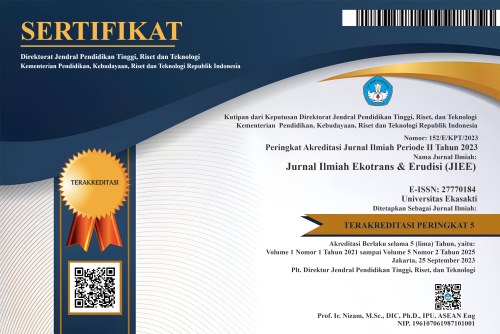

Jurnal Ilmiah Ekotrans & Erudisi (JIEE) is committed to ensuring that all scholarly manuscripts are evaluated through a rigorous, independent, transparent, fair, and ethically responsible editorial and peer review process.
Peer review constitutes a fundamental mechanism for assessing the scientific quality, originality, methodological rigor, theoretical contribution, analytical validity, ethical integrity, and relevance of manuscripts submitted to the journal.
JIEE adopts a double-blind peer review system in which the identities of authors and reviewers are concealed from one another during the evaluation process, subject to the reasonable limitations of anonymization.
This policy establishes the principles, responsibilities, assessment criteria, editorial procedures, revision requirements, confidentiality safeguards, conflict of interest provisions, and decision-making standards governing manuscript evaluation.
The policy is informed by the Committee on Publication Ethics (COPE) Core Practices, internationally recognized standards of scholarly peer review, and applicable Indonesian journal accreditation requirements.
The principal objectives of the JIEE peer review process are to:
Peer review is intended to improve scholarly quality and assess publication suitability. It does not guarantee the correctness of every research claim or replace the authors' responsibility for their work.
JIEE implements double-blind peer review for manuscripts that proceed beyond initial editorial screening.
Under this model:
Authors must remove names, affiliations, acknowledgments that disclose identity, identifying document metadata, and other unnecessary identifiers from manuscripts prepared for review.
Self-citations should follow appropriate academic conventions and must not be deliberately distorted merely to conceal author identity.
The journal recognizes that complete anonymity cannot always be guaranteed because research context, publicly available preprints, specialized methods, or other information may allow a reviewer to infer an author's identity.
Any such inference must not be used to compromise impartiality or confidentiality.
Manuscripts must be submitted through the official JIEE Open Journal Systems (OJS) platform.
The editorial office conducts an initial administrative assessment to determine whether the submission complies with the journal's requirements.
This assessment considers:
Manuscripts with correctable administrative deficiencies may be returned to the authors before scientific evaluation.
Submission through OJS does not guarantee that a manuscript will proceed to external peer review.
Following administrative screening, the Editor-in-Chief or an authorized editor assesses the manuscript's suitability for further scientific evaluation.
The desk evaluation considers:
The editor may return the manuscript for preliminary corrections, assign it for external review, or issue a desk rejection where substantial deficiencies make further review inappropriate.
Desk rejection may be justified by lack of scope alignment, insufficient scholarly contribution, fundamental methodological deficiencies, serious ethical concerns, or failure to meet essential submission standards.
The editorial decision should provide a clear explanation of the principal grounds for rejection.
Reviewers are selected according to their expertise, scholarly independence, competence, and ability to assess the subject and methods of the manuscript.
Relevant selection considerations include:
The journal seeks to involve reviewers with established research expertise and relevant publication records, including qualified national and international scholars.
Institutional and international diversity should contribute to independent scholarly evaluation rather than function solely as an administrative requirement.
Reviewers must not be selected merely to endorse a manuscript, supply favorable recommendations, or satisfy an appearance of independence without undertaking genuine assessment.
For research manuscripts proceeding to external peer review, JIEE's enhanced review standard requires three independent and substantive peer review reports before a final decision to accept a manuscript for publication.
Reviewer invitations, accepted invitations, or assignments that do not result in actual scholarly assessment do not count as completed review reports.
If an invited reviewer declines, withdraws, or does not submit an adequate review, the responsible editor should appoint an appropriate replacement.
Where reviewer recommendations are substantially inconsistent, the editor may seek additional independent expertise.
Each completed review must contain sufficient substantive assessment to inform editorial decision-making.
This enhanced standard applies prospectively after formal adoption and operational implementation. It does not constitute a claim that all manuscripts published before its effective implementation were evaluated by three reviewers.
Reviewers are invited through the journal's authorized editorial management process.
Before accepting an assignment, prospective reviewers must consider whether they:
Reviewers who lack appropriate expertise, face significant competing interests, or cannot meet the agreed requirements should decline the invitation promptly.
A reviewer who identifies a significant problem after accepting an assignment must inform the editor without unnecessary delay.
Reviewers are expected to provide evaluations that are intellectually rigorous, impartial, constructive, evidence-based, and respectful.
Reviewers must:
Reviewers should distinguish objective scientific concerns from preferences concerning theoretical perspectives, terminology, or writing style.
Reviewers assess manuscripts using criteria appropriate to the manuscript category and research design.
Does the manuscript address a meaningful scholarly question and provide a demonstrable theoretical, empirical, methodological, or policy-related contribution?
Is the research problem clearly formulated and critically situated within relevant previous scholarship? Are the research gap and objectives justified?
Are the selected theories and concepts appropriate, accurately interpreted, and analytically integrated into the research?
Are the methods appropriate to the research questions? Are data sources, selection procedures, measurements, analytical methods, and validation procedures adequately explained?
Are the findings supported by authentic and sufficiently reported evidence? Are the tables, figures, qualitative quotations, or statistical results accurately presented?
Does the discussion critically interpret the findings, address alternative explanations where relevant, and explain their relationship to existing scholarship?
Do the conclusions answer the research questions and remain within the limits of the evidence? Are implications proportionate and scientifically justified?
Are relevant ethical approval, informed consent, data availability, funding, author contribution, conflict of interest, and AI disclosure requirements addressed?
Are the references relevant, verifiable, sufficiently current where appropriate, and compliant with the journal's referencing requirements?
The review report must prioritize substantive scientific quality. Comments limited to formatting, language, or layout do not constitute an adequate scholarly review.
Review criteria must be adapted to the type of manuscript under consideration.
Original Research Articles: Reviewers should focus on research design, authentic data, methodological rigor, analysis, theoretical integration, and evidence-based conclusions.
Review Articles: Reviewers should examine the review question, search strategy, eligibility criteria, evidence selection, analytical transparency, synthesis quality, and original contribution.
Conceptual and Theoretical Articles: Reviewers should assess conceptual clarity, theoretical coherence, critical engagement with literature, originality of reasoning, and explanatory potential.
Policy and Governance Analysis Articles: Reviewers should evaluate the policy or institutional problem, analytical framework, documentary or empirical evidence, interpretation of governance mechanisms, and justification of policy implications.
Reviewers must not impose methodological requirements that are inappropriate for the manuscript's stated design merely because of personal disciplinary preferences.
A substantive peer review report should include:
Reviewers may provide confidential comments to the editor when appropriate, including concerns regarding research integrity, conflicts of interest, or the suitability of the manuscript.
Confidential comments must not be used to introduce unsupported accusations or discriminatory judgments.
Reviewer recommendations are advisory. They do not constitute the journal's final editorial decision.
JIEE recognizes four principal editorial decision categories:
Editors may request additional assessment when the available reviewer reports are insufficient or when substantial new issues emerge during revision.
Neither a favorable reviewer recommendation nor completion of a revision guarantees acceptance.
The Editor-in-Chief or authorized handling editor is responsible for making editorial decisions after considering the relevant reviewer reports, manuscript quality, author responses, and journal policies.
Editors must not make decisions primarily on the basis of author identity, institutional affiliation, nationality, academic rank, personal relationships, political positions, or financial considerations.
Reviewer recommendations should be weighed according to the quality and relevance of their scientific reasoning.
In cases of conflicting recommendations, editors should evaluate the underlying arguments and may request additional independent review.
The responsible editor must document significant decisions and provide authors with an appropriate explanation of the outcome.
Authors invited to revise their manuscripts must address the substantive concerns raised by reviewers and editors.
Revised submissions should ordinarily contain:
Authors should distinguish corrections that have been implemented from recommendations they respectfully disagree with.
Reasoned academic disagreement is permissible when supported by relevant evidence and clear justification.
Authors must not claim that analyses were performed, data were collected, or revisions were completed when this did not occur.
The handling editor examines revised manuscripts to determine whether the authors have addressed the major concerns raised during peer review.
Minor revisions may be assessed editorially when the requested changes are limited and do not require renewed specialist evaluation.
Major revisions may be returned to the original reviewers or assigned to additional qualified reviewers where appropriate.
Further review should focus on unresolved or newly emerging scientific issues rather than repeatedly introducing unrelated demands without reasonable justification.
A revised manuscript may be rejected if significant deficiencies remain unresolved or if new evidence demonstrates that publication standards have not been satisfied.
All unpublished manuscripts and associated review materials must be treated as confidential.
Editors, reviewers, and authorized editorial personnel must not disclose manuscript content, unpublished data, research ideas, reviewer reports, or editorial correspondence to unauthorized individuals.
Reviewers must not use unpublished findings, methods, or ideas for personal research, professional advantage, or other unauthorized purposes.
Reviewer identities are not disclosed to authors under the journal's double-blind review model.
Review records may be shared with authorized accreditation assessors or appropriate oversight bodies when necessary and subject to relevant confidentiality and access-control safeguards.
Such access must not be interpreted as permission to publish confidential review records or disclose reviewer identities publicly.
JIEE prohibits peer reviewers from using artificial intelligence technologies to perform or prepare the substantive review of submitted manuscripts.
Reviewers must not use generative AI or AI-assisted systems to:
Reviewers must not upload manuscripts, supplementary files, confidential review correspondence, or unpublished research materials into external AI services.
The journal maintains human responsibility and independent scholarly judgment as mandatory elements of peer review.
Editorial personnel must likewise comply with applicable restrictions on AI use and manuscript confidentiality.
Further requirements are governed by the journal's approved AI Usage Policy and Publication Ethics.
Editors and reviewers must disclose relationships or circumstances that could reasonably compromise, or appear to compromise, independent evaluation.
Relevant competing interests may include:
Reviewers with material competing interests should decline or withdraw from the assignment.
Editors with significant competing interests must transfer responsibility to an appropriately authorized independent editor.
Submissions involving editorial board members, journal personnel, or researchers affiliated with the publisher must be evaluated without preferential treatment and with appropriate independent oversight.
Where credible concerns arise regarding plagiarism, fabricated data, falsified results, inappropriate authorship, unethical research procedures, manipulated citations, or other research integrity violations, the editor must evaluate the concern through the applicable publication ethics procedures.
Reviewers should identify specific evidence and communicate concerns confidentially rather than making unsupported public allegations.
Authors must ordinarily be provided with a reasonable opportunity to respond to substantive concerns.
Manuscript processing may be suspended while significant issues are assessed.
Where formal investigation of researcher conduct is necessary, the journal may refer the matter to the relevant institution or competent authority.
Authors may submit a reasoned appeal when they believe an editorial decision was affected by a material factual error, procedural irregularity, unmanaged competing interest, or substantial misunderstanding of the manuscript.
An appeal must identify the decision being challenged and provide specific reasons and relevant supporting evidence.
Disagreement with an unfavorable reviewer recommendation alone does not establish grounds for overturning an editorial decision.
Appeals should be assessed by the Editor-in-Chief or, where a relevant conflict exists, another appropriately authorized independent editor.
Editorial complaints may be submitted through the JIEE Editorial Office.
Appeals and complaints must be considered fairly, consistently, and without retaliation.
JIEE seeks to conduct manuscript assessment and peer review efficiently without compromising scientific quality.
Review invitations and assignments are managed according to agreed deadlines communicated through the editorial process.
The actual duration of peer review may vary according to manuscript complexity, reviewer availability, the extent of required revisions, and other legitimate editorial considerations.
The journal does not guarantee a fixed acceptance date or publication outcome.
Authors should monitor their submission status through OJS and communicate significant concerns through the journal's authorized correspondence channels.
JIEE uses its online journal management system to support the documentation and traceability of manuscript evaluation.
Relevant records should include:
These records support accountability, quality assurance, and appropriate evaluation by authorized accreditation assessors.
Review records must not be fabricated, retrospectively represented as contemporaneous assessments, or created merely to satisfy accreditation requirements.
Access, retention, and disclosure of review records must comply with the journal's confidentiality obligations and applicable institutional policies.
Article Processing Charges are administered separately from scholarly evaluation and editorial decision-making.
Payment does not guarantee manuscript acceptance, favorable reviewer recommendations, accelerated editorial treatment, or publication.
Editorial decisions are made according to the scientific and ethical standards of the journal.
Information regarding applicable publication charges is available in the Article Processing Charge Policy.
Peer review and manuscript acceptance do not eliminate the possibility that significant errors or integrity concerns may emerge after publication.
Authors, readers, and other stakeholders may communicate evidence-based concerns regarding published articles to the editorial office.
Where necessary, JIEE may seek additional expert assessment and determine whether a correction, Expression of Concern, retraction, or other appropriate notice is required.
Post-publication action must be based on relevant evidence and conducted in accordance with the journal's publication ethics procedures.
At each relevant stage, the journal must preserve an appropriate record of the activities actually undertaken.
This Peer Review Policy should be read in conjunction with the following JIEE resources:
The policy is informed by internationally recognized guidance, including:
Reference to international standards does not imply formal membership of, certification by, or endorsement from these organizations.
This Peer Review Policy becomes effective following formal approval and publication by the responsible JIEE editorial management.
The journal should implement the approved requirements consistently through OJS, its reviewer instructions, and its editorial operating procedures.
Any prospective change in reviewer numbers, confidentiality requirements, review procedures, or scientific assessment standards should be documented and communicated appropriately.
The editorial team should periodically review the effectiveness of its peer review procedures and make improvements where justified by experience, evidence, and evolving scholarly publishing standards.
JIEE maintains that independent, substantive, evidence-based, and ethically responsible peer review is essential to protecting scholarly quality, editorial credibility, and public trust in published research.
Accreditation and Certificate
Template


Support By



Tools