Accreditation and Certificate
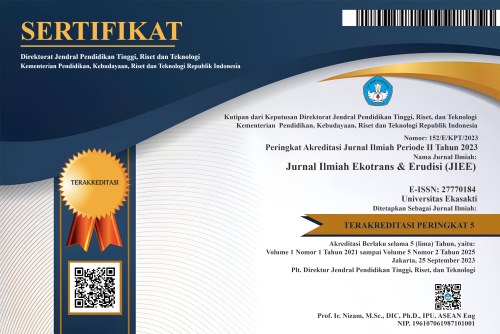

Jurnal Ilmiah Ekotrans & Erudisi (JIEE) is a peer-reviewed, open-access scholarly journal dedicated to advancing theoretical, empirical, and methodological knowledge in public administration, governance, public policy, and related fields of social and political sciences. Published by the Faculty of Social and Political Sciences and the Institute for Research and Community Service (LPPM), Universitas Ekasakti, Indonesia, JIEE provides a scholarly platform for the dissemination of original research addressing contemporary administrative, institutional, organizational, and societal challenges.
The journal promotes interdisciplinary academic inquiry by integrating perspectives from public administration, political science, management, economics, law, and organizational studies. Its central scholarly orientation concerns the relationships between public institutions, governance arrangements, organizational processes, policymaking, and social development.
The primary objective of JIEE is to contribute to the advancement of scientific knowledge through the publication of rigorous, original, and relevant scholarly research that strengthens theoretical understanding, informs evidence-based policymaking, and supports improvements in institutional and organizational practices.
Specifically, JIEE seeks to:
JIEE primarily focuses on the study of public administration, governance, and public policy, with particular attention to the functioning, transformation, performance, and accountability of public institutions and organizations.
The journal is especially interested in research explaining how institutional structures, administrative processes, leadership, organizational behaviour, policy instruments, and governance relationships influence organizational effectiveness, public service delivery, policy outcomes, and broader societal development.
JIEE also welcomes interdisciplinary studies in management, economics, information systems, and law when their research questions, theoretical frameworks, empirical findings, or implications establish a clear connection to institutional governance, organizational development, public administration, or social transformation.
The scholarly scope of JIEE encompasses the following interconnected research areas:
Research concerning administrative systems, public sector management, administrative reform, bureaucratic structures, institutional effectiveness, public service delivery, administrative accountability, and the development of public organizations.
Studies examining public policy formulation, implementation, monitoring, evaluation, policy instruments, policy coordination, regulatory governance, evidence-based policymaking, and the institutional determinants of policy performance.
Research addressing good governance, collaborative governance, network governance, multilevel governance, institutional capacity, decentralization, intergovernmental relations, stakeholder participation, transparency, and institutional accountability.
Studies investigating public and organizational leadership, organizational culture, employee behaviour, institutional commitment, motivation, decision-making, organizational change, and leadership effectiveness in public and other relevant organizations.
Research focusing on strategic planning, strategic implementation, organizational capabilities, operational management, performance measurement, organizational innovation, institutional competitiveness, and organizational effectiveness.
Studies concerning public financial management, budgeting, fiscal governance, financial accountability, institutional financial performance, public expenditure management, audit, and the governance of financial resources.
Research examining human resource planning, recruitment, employee development, competency management, performance appraisal, organizational commitment, workforce transformation, and strategic human resource management, particularly in public and institutional settings.
Studies addressing knowledge creation, knowledge sharing, organizational learning, institutional memory, knowledge-based decision-making, innovation processes, and the role of organizational knowledge in improving institutional performance.
Research investigating governance structures, board effectiveness, organizational ethics, institutional transparency, stakeholder relationships, corporate accountability, sustainability governance, and responsible organizational management.
Studies exploring management information systems, digital transformation, electronic government, digital public services, information management, data-driven decision-making, technology adoption, and the organizational implications of digital innovation.
Research addressing administrative law, regulatory frameworks, legal institutions, public sector regulation, policy implementation, institutional compliance, regulatory effectiveness, and the interactions between legal systems, public institutions, and governance practices.
Interdisciplinary research examining political institutions, civic participation, social change, regional development, public welfare, political accountability, and the relationships between governance arrangements and societal outcomes.
JIEE encourages interdisciplinary research that integrates theoretical and methodological perspectives to explain complex administrative, organizational, political, economic, legal, and social phenomena.
The journal welcomes comparative studies across organizations, regions, countries, institutional systems, and governance settings, particularly when such comparisons contribute to broader theoretical understanding or produce transferable analytical insights.
Research conducted in local or national contexts is equally relevant when it addresses significant scholarly questions, demonstrates methodological rigor, and explains the implications of its findings beyond a purely descriptive account of the research setting.
JIEE welcomes theoretically informed and empirically grounded scholarship employing research designs appropriate to the questions being investigated. These may include qualitative research, quantitative analysis, mixed-methods research, comparative case studies, longitudinal research, systematic evidence synthesis, and other scientifically defensible approaches.
Manuscripts should demonstrate the following scholarly characteristics:
JIEE particularly values manuscripts that move beyond the description of administrative or organizational phenomena by offering critical explanations, analytical interpretations, theoretical refinements, or novel empirical insights.
All submitted manuscripts are assessed for their relevance to the journal's stated objectives and scholarly scope. Interdisciplinary submissions must clearly demonstrate how their research contributes to one or more of the journal's core fields.
Manuscripts dealing primarily with technical, commercial, financial, or disciplinary issues without a meaningful connection to governance, administration, organizational studies, public policy, or relevant social science questions may be considered outside the journal's scope.
Similarly, studies that are exclusively descriptive, lack a clearly defined research contribution, or do not provide sufficient methodological and analytical justification may be considered unsuitable for further editorial evaluation.
Editorial assessment is based on scholarly relevance, originality, methodological appropriateness, analytical rigor, research integrity, and the significance of the manuscript's contribution. Manuscripts selected for external evaluation undergo the journal's established peer review process, and publication decisions remain the responsibility of the editorial team.
JIEE serves an interdisciplinary readership comprising academics, researchers, graduate students, policymakers, public administrators, organizational leaders, and professionals interested in public administration, governance, institutional development, and related social sciences.
Through the dissemination of accessible and scientifically rigorous research, JIEE seeks to strengthen scholarly communication, facilitate knowledge exchange, and contribute to the development of theoretical understanding and informed institutional practice at local, national, and international levels.
Accreditation and Certificate
Template


Support By



Tools