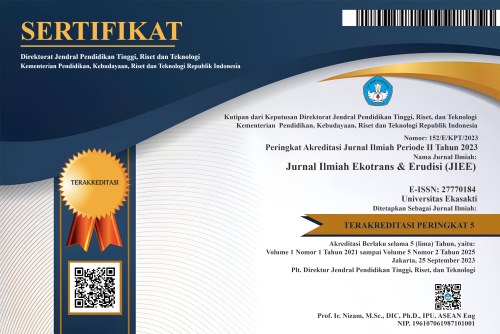
Accreditation and Certificate
Jurnal Ilmiah Ekotrans & Erudisi (JIEE) is committed to maintaining the integrity, objectivity, independence, transparency, and credibility of scholarly research and academic publishing. The journal recognizes that conflicts of interest, also referred to as competing interests, may arise during research design, data collection, analysis, manuscript preparation, peer review, editorial decision-making, and publication.
This policy establishes the principles and procedures for identifying, disclosing, evaluating, and managing actual, potential, and perceived conflicts of interest involving authors, editors, editorial board members, peer reviewers, journal personnel, and the publisher.
JIEE requires relevant interests and relationships to be disclosed transparently so that appropriate measures can be taken to safeguard the independence of scientific evaluation and maintain public trust in published research.
The policy is informed by the guidance of the Committee on Publication Ethics (COPE), the International Committee of Medical Journal Editors (ICMJE), and internationally recognized principles of transparency and best practice in scholarly publishing.
The purpose of this policy is to establish a consistent and accountable framework for the disclosure and management of competing interests throughout the scholarly publishing process.
Specifically, this policy aims to:
This policy applies to all manuscripts submitted to JIEE and to all parties participating in their evaluation, publication, and post-publication management.
A conflict of interest exists when an individual's professional judgment, research interpretation, peer review assessment, editorial decision, or publication responsibility may be influenced, or could reasonably be perceived as being influenced, by secondary interests or relationships.
Such interests may be financial or non-financial and may involve individuals, institutions, organizations, funding bodies, professional associations, or other relevant parties.
JIEE distinguishes among three forms of conflict of interest:
The existence of a competing interest does not necessarily imply misconduct or invalidate research findings. However, failure to disclose a relevant interest may undermine the credibility of the research and the transparency of the publication process.
Disclosure allows editors and readers to assess whether particular relationships or interests may be relevant to the interpretation of the scholarly work.
Financial conflicts may arise when an individual has financial relationships or interests that could influence, or appear to influence, research activities or publication decisions.
Examples include:
Authors must disclose financial relationships that are relevant to the research or could reasonably be perceived as influencing its design, implementation, interpretation, or reporting.
Personal and professional conflicts may arise from relationships that could compromise independent scholarly evaluation.
Examples include:
Relevant relationships must be disclosed even when an individual believes that the relationship will not affect their objectivity.
Academic or intellectual conflicts may arise when strongly held scholarly positions, professional commitments, research competition, or intellectual interests could compromise objective evaluation.
Examples include:
Scientific disagreement alone does not constitute a conflict of interest. Reviewers and editors are expected to assess competing theories and interpretations on their scholarly merits.
Institutional conflicts may arise when organizational relationships, administrative authority, or institutional priorities interfere with independent scientific evaluation.
Examples include:
Institutional affiliation alone does not automatically establish misconduct. However, relationships that create a reasonable risk of bias must be disclosed and appropriately managed.
Because JIEE publishes research in public administration, governance, public policy, and related social sciences, competing interests may also involve political, governmental, regulatory, or advocacy relationships.
Relevant examples include:
Political opinions or professional policy expertise do not automatically disqualify a researcher from conducting or publishing scholarly work. Disclosure is required when a relationship or commitment could reasonably influence, or appear to influence, the research or editorial process.
All authors are responsible for identifying and disclosing relevant competing interests associated with their submitted research.
Each author must consider whether any financial, personal, academic, institutional, professional, political, or other relationship could reasonably be perceived as influencing the manuscript.
Authors are required to:
The corresponding author is responsible for coordinating the disclosure process and ensuring that the manuscript contains an accurate statement reflecting the relevant interests of all authors.
Responsibility for disclosure remains with each individual author, even when the corresponding author submits the declaration on behalf of the author group.
Every manuscript submitted to JIEE must contain a Conflict of Interest or Competing Interests statement.
The declaration should be placed in the manuscript's declarations section, preferably before the references or in another location specified by the journal's approved manuscript template.
Authors who have no relevant competing interests should include the following statement:
Conflict of Interest: The authors declare that they have no financial or non-financial competing interests that could have influenced the research, analysis, interpretation, or publication of this manuscript.
Authors with relevant competing interests must provide a clear and specific disclosure.
The following is an illustrative example:
Conflict of Interest: One author has served as a paid consultant to an organization involved in the policy area examined in this study. This relationship has been disclosed to the journal. The remaining authors declare no relevant competing interests.
Authors must replace the illustrative statement with an accurate description of their own circumstances. A disclosure does not automatically result in rejection, but the editorial team may request additional information or establish appropriate measures to manage potential bias.
Research funding must be reported separately, including the identity of relevant funding organizations and the role of the funder where applicable.
An illustrative statement is:
Funding: This research received financial support from the funding organization identified in the manuscript. The funder had no role in the study design, data collection, analysis, interpretation, manuscript preparation, or decision to submit the article for publication.
This statement must only be used when it accurately reflects the funding arrangement. Where a sponsor participated in research activities or influenced publication decisions, that involvement must be described transparently.
Where no external funding was received, authors may state:
Funding: This research received no external funding.
A funding declaration does not replace the obligation to disclose other relevant competing interests.
Peer reviewers are responsible for providing independent, objective, confidential, and scientifically justified assessments of manuscripts assigned to them.
Before accepting a review invitation, reviewers must assess whether they have relationships or interests that could compromise their impartiality.
Reviewers must disclose relevant competing interests to the responsible editor and decline or withdraw from assignments when their ability to provide an independent assessment is reasonably compromised.
Potential grounds for declining a review assignment include:
Consistent with COPE guidance, reviewers should pay particular attention to recent collaborations, including relevant collaborative relationships within the preceding three years.
Reviewers who become aware of an undisclosed conflict after accepting an assignment must inform the responsible editor promptly.
They must not use confidential manuscript information, unpublished research findings, or privileged knowledge gained through peer review for personal, academic, commercial, or professional advantage.
Reviewer recommendations for additional citations must be based on genuine scholarly relevance and must not be used to increase personal citation metrics.
Editors and editorial board members are responsible for ensuring that manuscript evaluation and publication decisions are conducted independently of inappropriate external or personal influence.
Editors must disclose relevant competing interests and withdraw from handling manuscripts where their relationships or interests could reasonably compromise their impartiality.
Such circumstances may include:
When a conflict is identified, the manuscript must be reassigned to another suitably qualified editor without a relevant conflict of interest.
The conflicted editor must not participate in reviewer selection, reviewer recommendation assessment, manuscript evaluation, or the final publication decision for the affected submission.
Editorial Board membership does not provide preferential treatment to manuscripts submitted by board members or their collaborators.
Where a manuscript is submitted by the Editor-in-Chief, Managing Editor, or another editorial decision-maker, responsibility for its assessment must be assigned to an independent and appropriately authorized editor.
The journal should document such reassignments and preserve sufficient evidence that the manuscript underwent an independent editorial and peer review process.
Universitas Ekasakti, as the institutional publisher of JIEE, supports the journal's scholarly mission while respecting the independence of scientific editorial decisions.
Institutional ownership, financial support, administrative authority, or organizational relationships must not be used to improperly influence manuscript acceptance, reviewer selection, research interpretation, or publication decisions.
The publisher and journal management should ensure that:
Manuscripts submitted by researchers affiliated with the publishing institution must meet the same scientific, ethical, and editorial standards as manuscripts from external institutions.
Where an institutional relationship creates a significant conflict, appropriate independent editorial arrangements must be established.
Research sponsors and funding organizations may provide legitimate support for scientific activities. However, financial support must not compromise the independence of research findings, data interpretation, manuscript preparation, or publication decisions.
Authors must disclose the identity and relevant role of funding organizations or sponsors.
Editors may request clarification regarding:
Where a funder or sponsor has influenced the design, analysis, interpretation, or publication of a study, this involvement must be disclosed accurately.
Authors must not conceal sponsor involvement or misrepresent the independence of their research.
JIEE recognizes the importance of maintaining a clear separation between financial administration and academic editorial decision-making.
Article Processing Charges, where applicable, must not influence the scientific evaluation of manuscripts or determine publication acceptance.
The payment or prospective payment of publication fees does not guarantee acceptance, favorable reviewer recommendations, expedited scientific approval, or exemption from editorial requirements.
Requests for fee waivers or financial assistance must not negatively influence editorial decisions.
The responsible editor must evaluate submissions based on scholarly quality, relevance, originality, methodological appropriateness, analytical rigor, and research integrity.
Information concerning applicable publication charges and waivers is provided in the journal's Article Processing Charge policy.
JIEE adopts a structured process for addressing disclosed or suspected competing interests.
Relevant interests must be disclosed at the earliest appropriate stage of manuscript submission, reviewer invitation, editorial assignment, or other publication-related involvement.
The responsible editor evaluates the disclosed information to determine whether the relationship presents an actual, potential, or perceived conflict requiring action.
The evaluation should consider the nature of the relationship, its relevance to the manuscript, the individual's role in the publication process, and the likelihood that impartiality could reasonably be questioned.
Depending on the seriousness and nature of the conflict, appropriate measures may include:
Relevant disclosures, editorial assessments, reassignments, and management decisions should be documented through the journal's authorized editorial records.
Confidential information must be handled in accordance with applicable privacy, institutional, and publication ethics requirements.
Authors, editors, and reviewers must promptly report material changes in relevant interests during the manuscript evaluation and publication process.
Previously undisclosed interests that become known before publication must be assessed before the editorial process is finalized.
Where a potentially significant undisclosed conflict is identified, JIEE will assess the circumstances objectively and proportionately.
The responsible editor may request an explanation from the individual concerned, examine relevant evidence, and determine whether the relationship affects the reliability or independence of the research or publication process.
Possible editorial actions include:
Failure to disclose an interest is not automatically equivalent to fabrication, falsification, or other forms of research misconduct. The journal must evaluate the nature of the omission, its significance, the available evidence, and the appropriate response.
Knowingly providing false or misleading disclosure information may constitute a serious publication ethics concern.
JIEE recognizes that previously undisclosed competing interests may become known after an article has been published.
When such concerns are reported, the editorial team will assess whether the undisclosed relationship is relevant to the article's findings, interpretation, reliability, or publication process.
Depending on the outcome of the assessment, appropriate actions may include:
The existence of an undisclosed conflict does not automatically justify retraction. Editorial responses must be proportionate to the nature of the conflict and its demonstrated implications for the scholarly record.
Corrections and other post-publication notices should remain linked to the relevant article and be communicated transparently.
Authors, reviewers, readers, and other interested parties may report concerns regarding undisclosed conflicts of interest or inappropriate influence in the editorial process.
Reports should be submitted through the journal's official Contact page and should contain sufficient information to identify the relevant manuscript, publication, relationship, or editorial decision.
Where a complaint directly concerns the Editor-in-Chief or another responsible editor, the matter should be assigned to an appropriately authorized individual who is independent of the alleged conflict.
The journal should ensure that:
Where formal investigation of individual conduct is required, the journal may cooperate with the relevant institution while retaining responsibility for appropriate publication-related decisions.
JIEE expects published articles to contain an appropriate Conflict of Interest or Competing Interests declaration.
Where authors report no relevant competing interests, the article should include an explicit statement to that effect.
Where competing interests exist, the published declaration should provide sufficient information for readers to understand the nature of the relevant relationships without unnecessarily disclosing unrelated private information.
Funding declarations should identify relevant funding sources and explain the role of sponsors when applicable.
Editorial disclosure information must be accurate, and conflicts involving editors or reviewers should be documented internally through appropriate publication management procedures.
The journal should periodically review the completeness and consistency of competing interests declarations as part of its editorial quality assurance activities.
This policy should be implemented consistently with the journal's other editorial and publication ethics policies.
Where several editorial policies apply to the same matter, the responsible editor should ensure that decisions are consistent, transparent, and supported by appropriate documentation.
The principles established in this policy are informed by the following resources:
This Conflict of Interest and Competing Interests Policy establishes the journal's framework for transparent disclosure, independent evaluation, and appropriate management of competing interests.
The policy becomes effective upon formal approval and publication by the responsible JIEE editorial management.
The editorial team should periodically review the policy to maintain consistency with internationally recognized publication ethics guidance, relevant institutional requirements, and the journal's operational procedures.
Any material changes to the policy should be communicated transparently through the official journal website.
Accreditation and Certificate
Template


Support By



Tools