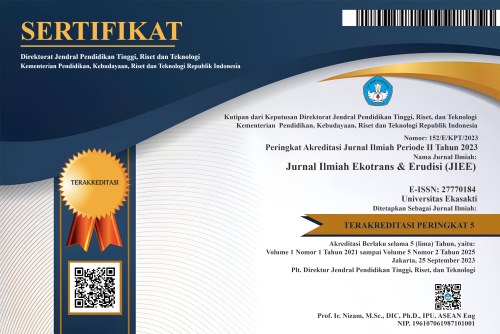
Accreditation and Certificate

Jurnal Ilmiah Ekotrans & Erudisi (JIEE) recognizes that artificial intelligence (AI), including generative AI and AI-assisted technologies, can support scholarly research, manuscript preparation, scientific analysis, and academic communication. However, the responsible use of these technologies must be guided by academic integrity, transparency, human accountability, methodological rigor, intellectual property rights, and the protection of confidential information.
JIEE permits responsible AI assistance in defined scholarly activities but does not allow AI technologies to replace the independent intellectual contributions, scientific judgment, ethical responsibilities, or accountability of human researchers, authors, editors, and peer reviewers.
This policy establishes the journal's requirements for the use, disclosure, verification, and management of AI-assisted technologies throughout the research and scholarly publication process.
The policy is informed by the guidance of the Committee on Publication Ethics (COPE), the International Committee of Medical Journal Editors (ICMJE), and the World Association of Medical Editors (WAME), as well as evolving international standards concerning responsible AI use in scholarly communication.
The purpose of this policy is to establish a transparent framework that enables appropriate use of AI technologies while protecting the originality, reliability, confidentiality, and integrity of scholarly work submitted to or published in JIEE.
The policy applies to:
This policy applies to all manuscript categories accepted under the journal's approved submission requirements.
Artificial Intelligence refers to computational systems capable of performing tasks that may involve learning, classification, prediction, language processing, pattern recognition, content generation, or other forms of automated analysis and decision support.
Generative AI refers to technologies that produce text, images, audio, video, computer code, analytical summaries, or other content in response to prompts or input data.
Examples may include large language models, AI-powered writing assistants, automated content generation systems, AI image generators, and multimodal generative models.
The application of this policy is determined by how a technology is used rather than by a particular commercial product name.
AI-assisted research tools may include systems used for text classification, qualitative coding support, statistical modeling, machine learning, automated transcription, literature organization, document analysis, or other computational research activities.
Where such systems materially influence the research design, collection of evidence, analysis, interpretation, or reporting, their use must be described transparently in the manuscript.
Routine digital assistance includes ordinary spelling and grammar checking, basic formatting functions, conventional reference management, and other non-substantive technical support that does not generate original scholarly arguments, research findings, or material changes to the manuscript.
Such activities are distinguished from substantive generative AI assistance for disclosure purposes.
JIEE establishes the following principles for responsible AI use in scholarly publishing:
JIEE allows responsible AI assistance when the technology supports legitimate scholarly activities and the authors remain fully accountable for the resulting manuscript.
Authors may use digital tools to improve spelling, grammar, punctuation, readability, and linguistic clarity.
Routine spelling, grammar, and punctuation checks that do not materially alter the manuscript's scientific content do not require a separate AI declaration.
When a generative AI tool substantially rewrites text, reorganizes arguments, drafts significant passages, or materially changes the presentation of scholarly content, the assistance must be disclosed.
All modifications must be checked carefully to ensure that the intended meaning, disciplinary terminology, research evidence, and original scholarly arguments remain accurate.
AI tools may assist authors in organizing manuscript sections, evaluating clarity, suggesting outlines, or identifying areas requiring stronger explanation.
Such assistance must not replace independent formulation of the research problem, selection of theoretical perspectives, interpretation of findings, or development of original scholarly contributions.
Substantive AI assistance in reorganizing or drafting the manuscript must be disclosed.
AI tools may assist researchers in identifying search terms, developing literature search strategies, organizing bibliographic information, or locating potentially relevant scholarly sources.
However, authors must independently verify the existence, bibliographic accuracy, relevance, and substantive content of every cited source.
AI-generated summaries must not be treated as substitutes for examining the original scholarly publications.
Authors must not rely on unsupported AI-generated statements concerning previous research, theoretical contributions, or the existence of research gaps.
AI technologies may be used for legitimate research activities such as machine learning, data classification, automated coding assistance, statistical programming, computational modeling, and other analytical procedures.
When these technologies form a substantive part of the research methodology, authors must describe their use in the Methods section with sufficient detail for scientific evaluation.
Authors must explain the analytical purpose, relevant tools, verification procedures, and limitations of the AI-assisted approach.
AI-assisted translation may be used to support the communication of scholarly material when authors verify the accuracy of the translation and preserve the intended scientific meaning.
Substantive generative AI translation or rewriting of manuscript content should be disclosed.
Routine accessibility assistance or non-substantive language support that does not materially generate or alter scholarly content does not ordinarily require a separate declaration.
Regardless of the assistance used, authors remain responsible for the final submitted language and the accuracy of specialized terminology.
JIEE prohibits the use of AI technologies for activities that compromise research integrity, authorship accountability, editorial independence, confidentiality, or the authenticity of scholarly evidence.
Prohibited practices include:
These prohibitions apply regardless of whether the resulting content appears scientifically plausible or is difficult to distinguish from human-generated material.
Artificial intelligence systems, large language models, chatbots, and other automated technologies cannot be listed as authors or co-authors of scholarly manuscripts submitted to JIEE.
Authorship involves responsibilities that AI technologies cannot fulfill, including:
Only eligible human contributors may receive authorship credit.
The use of AI assistance does not establish authorship eligibility or remove the responsibility of human authors to make genuine scholarly contributions.
All listed authors must review and approve the final manuscript, including AI-assisted content, and remain accountable for its accuracy and integrity.
JIEE requires transparent disclosure when generative AI or AI-assisted technologies materially contribute to manuscript drafting, substantive editing, theoretical or analytical development, research design, data processing, interpretation, or the preparation of scholarly figures.
Such disclosure must be sufficiently informative to establish:
The disclosure must not suggest that a tool has performed research procedures, analyses, or verification activities that were not actually undertaken.
Where AI is used as part of the research methodology, its use must also be described in the Methods section, even when a separate declaration is included.
Authors should include a clearly labeled section entitled Declaration of AI-Assisted Tools in the manuscript declarations section before the references, unless otherwise specified in the journal's approved template.
In a double-blind review submission, the declaration should not contain unnecessary information that reveals the identities of the authors.
The corresponding author must ensure that relevant AI assistance is accurately disclosed at submission and updated when material changes occur during revision.
Declaration of AI-Assisted Tools: During the preparation of this manuscript, the authors used [name of AI tool] to assist with [describe the specific language editing, translation, or manuscript organization activities]. The authors independently reviewed and revised the resulting content, verified its accuracy, and retained full responsibility for the scientific arguments, references, conclusions, and integrity of the manuscript.
Declaration of AI-Assisted Tools: The authors used [name and version of AI tool] to assist with [describe the analytical activity]. The relevant procedures, inputs, outputs, and verification methods are reported in the Methods section. The authors independently evaluated the analytical results and retain full responsibility for the interpretation and accuracy of the findings.
Declaration of AI-Assisted Tools: The authors used [name of AI tool] to assist in preparing [identify the figure or illustration]. The visual material was reviewed and verified by the authors, does not represent fabricated empirical evidence, and is used in accordance with applicable copyright and licensing requirements.
Declaration of AI-Assisted Tools: The authors declare that no generative AI tools were used to produce or materially revise the substantive scholarly content, research data, analyses, or interpretations presented in this manuscript.
Authors must adapt the applicable example to their actual circumstances. A declaration must never be copied into a manuscript if it does not accurately describe the work performed.
AI-assisted research methods are subject to the same requirements of transparency, validity, appropriateness, reliability, and ethical justification as other research methods.
Where AI is used for research design, document classification, qualitative coding, statistical modeling, machine learning, or related substantive activities, authors should report:
Authors should provide sufficient information to permit informed scientific evaluation without unnecessarily disclosing confidential research materials, sensitive personal data, proprietary information, or other protected content.
The use of sophisticated AI tools does not compensate for weaknesses in research design, sampling, data quality, causal inference, or theoretical interpretation.
Authors using AI for quantitative research must maintain transparency concerning the data, statistical models, computational procedures, and interpretation of results.
AI-assisted generation or revision of statistical code may be permitted when the code is independently examined and its results are verified using appropriate analytical procedures.
Authors must not report unexecuted analyses as completed research or present hypothetical AI-generated numerical outputs as actual findings.
Important statistical claims must be supported by appropriate calculations, verified analyses, and authentic research data.
Where machine learning or related AI models are used as research methods, authors should describe relevant model development, validation, performance assessment, and limitations.
AI-generated predictions and simulated outputs must be identified accurately and distinguished from observed empirical data.
Authors may use appropriate AI-assisted tools to support qualitative research activities such as transcription, preliminary text organization, document classification, and exploratory coding.
Such assistance does not replace the researcher's responsibility for interpreting participant accounts, understanding contextual meaning, assessing competing explanations, or establishing analytical credibility.
Where AI-assisted qualitative analysis materially influences the research findings, authors must describe the analytical process and the role of human verification.
Interview transcripts, observational notes, confidential documents, and other qualitative research materials must not be uploaded to unauthorized services when doing so would violate participant consent, privacy obligations, or institutional restrictions.
Researchers must not create fictional participant quotations or misrepresent generated narratives as authentic interview evidence.
Illustrative or synthetic text used for methodological demonstration must be identified explicitly and must not be presented as genuine field evidence.
JIEE distinguishes legitimate scientific use of synthetic data or simulation from fabrication of research evidence.
Synthetic data may be used in appropriately designed methodological, computational, simulation, or validation research when the nature and purpose of those data are clearly disclosed.
Authors must explain how synthetic data were generated, their relationship to real-world evidence, their limitations, and the conclusions that can reasonably be drawn from them.
Authors must not present synthetic respondents, fabricated interviews, simulated observations, or generated institutional records as authentic empirical data collected from real individuals or organizations.
If a study combines actual and synthetic data, the manuscript must distinguish the sources clearly and explain the methodological implications.
Research claims must remain consistent with the evidentiary status of the data analyzed.
AI tools may support literature discovery, search-term development, document organization, and other activities associated with scholarly reviews.
Authors conducting systematic reviews, scoping reviews, bibliometric analyses, or other evidence syntheses must maintain transparent and verifiable review procedures.
AI-generated literature summaries must not replace systematic examination of the source publications.
Where AI materially supports the identification, screening, classification, or synthesis of studies, authors should describe the tool's role, validation procedures, and relevant limitations.
Bibliographic datasets, search strategies, eligibility criteria, screening decisions, and substantive interpretations must remain scientifically defensible.
Authors must not generate fictional studies, invent bibliometric records, or report simulated literature datasets as authentic database retrieval results.
Claims concerning research gaps, intellectual structures, research trends, or theoretical contributions must be supported by verifiable scholarly evidence.
AI-generated visual materials require particular attention to scientific accuracy, transparency, originality, and intellectual property rights.
JIEE may consider AI-assisted conceptual illustrations, explanatory diagrams, or other non-empirical visual materials when their use is scientifically justified, appropriately disclosed, and consistent with the journal's editorial requirements.
Such materials must not misrepresent research findings or suggest the existence of evidence that was not collected.
The following practices are prohibited:
Authors must explain the role of AI in generating or materially modifying figures when the assistance is relevant to the scholarly content.
Editors may request source files, explanatory information, or supporting documentation where concerns arise regarding the authenticity or interpretation of visual material.
Authors must independently verify all citations and references, including those suggested or produced by AI-assisted tools.
Before including a reference, authors must confirm that the publication exists and that the cited material supports the relevant statement.
Reference verification should include, where applicable:
Fabricated references, invented DOI identifiers, nonexistent research findings, and misleading citations are unacceptable regardless of whether they originate from AI tools or other sources.
AI-generated references must not be used without independent verification.
AI tools may involve the transfer, processing, storage, or reuse of information by third-party services. Such practices may create risks for confidential scholarly materials and research participants.
Authors, reviewers, and editors must protect confidential information and comply with applicable privacy and data protection requirements.
Protected information may include:
Users must not upload protected materials to AI services unless there is an appropriate legal and ethical basis, all necessary authorizations have been obtained, and the service provides safeguards suitable for the information involved.
Before using an external AI service with research materials, authors should assess the service's relevant data handling, retention, confidentiality, and intellectual property terms.
De-identification should be assessed carefully because removing names alone may not prevent the re-identification of individuals from contextual information.
Peer reviewers must conduct independent and confidential scientific evaluations of manuscripts entrusted to them.
Reviewers must not upload unpublished JIEE manuscripts, manuscript excerpts, supplementary files, review reports, or confidential editorial correspondence to public or otherwise unauthorized generative AI services.
Such disclosure may compromise the confidentiality of the peer review process and the intellectual property or privacy rights of authors and research participants.
Reviewers must not delegate their substantive scientific assessment to generative AI systems or submit AI-generated reviewer reports as a substitute for independent scholarly judgment.
Reviewers remain personally responsible for the accuracy, fairness, relevance, and scholarly quality of their recommendations.
Routine spelling or grammar checking of a reviewer's independently written comments may be used only in a manner that does not expose confidential manuscript information to unauthorized systems.
Any proposed use of AI involving confidential review information must receive explicit prior authorization from the responsible editor and must comply with the necessary confidentiality safeguards.
Reviewers must disclose any permitted substantive AI assistance used during their review activities.
When reviewers suspect inappropriate AI use by an author, they should report the specific concern and supporting evidence confidentially to the editor rather than making unsupported accusations.
Editors are responsible for maintaining independent scientific judgment, confidentiality, fairness, and accountability throughout the manuscript evaluation and publication process.
Editors and editorial board members must not upload confidential manuscripts, reviewer reports, author correspondence, or unpublished research materials to unauthorized generative AI services.
Generative AI must not be used as an independent decision-maker for manuscript acceptance, rejection, reviewer evaluation, or publication ethics determinations.
Editorial decisions must be based on human assessment of the manuscript, relevant scholarly evidence, independent review, and the journal's approved editorial standards.
Where authorized technical tools assist with administrative activities, similarity screening, metadata quality, or other limited editorial functions, their use must remain subject to appropriate human oversight, confidentiality protections, and institutional authorization.
Automated similarity assessments and AI-related analytical outputs must not be treated as conclusive evidence of research misconduct.
Editors remain responsible for explaining and documenting significant editorial decisions.
Universitas Ekasakti, as the institutional publisher associated with JIEE, supports responsible scholarly communication and the protection of publication integrity.
AI-assisted administrative tools may be considered for suitable publishing functions when their use is authorized and consistent with relevant information security, privacy, confidentiality, and publication ethics requirements.
Such functions may include administrative document organization, limited metadata checks, or other non-decisional technical support.
AI technologies must not be allowed to independently replace editorial authority or determine the scientific acceptability of submitted research.
Institutional and editorial personnel remain accountable for their respective publishing responsibilities.
JIEE recognizes that automated systems intended to identify AI-generated content have limitations and may produce incorrect, inconsistent, or misleading classifications.
AI detection scores must not be treated as conclusive or standalone evidence of misconduct.
The journal does not establish an automatic rejection threshold based solely on a numerical AI-generated-content score.
Where concerns arise, the editorial team should consider relevant evidence, including:
Detection results may inform a preliminary inquiry where appropriate but must be evaluated in context and supplemented by meaningful evidence.
Authors must not be presumed to have committed misconduct solely because of writing style, linguistic characteristics, use of language assistance, or the output of an automated detector.
Where credible concerns arise concerning AI-related research or publication misconduct, the editorial office should apply a fair and proportionate assessment procedure.
The procedure may involve:
Authors should ordinarily be given a reasonable opportunity to respond to substantive concerns before an adverse determination is finalized.
The journal must distinguish accidental errors, inadequate AI disclosure, legitimate methodological disagreement, and deliberate misrepresentation of research evidence.
Where a violation of this policy is supported by sufficient evidence, the journal may take appropriate editorial action according to the seriousness of the concern.
Possible actions include:
The presence of undisclosed AI assistance does not automatically establish fabrication, plagiarism, or other serious misconduct.
Editorial responses must consider the nature and extent of the assistance, the accuracy of the published work, the available evidence, and whether appropriate corrective action is possible.
Retraction must not be used automatically or punitively merely because an AI tool was used.
Authors remain responsible for the reliability of published work when AI-assisted technologies have contributed to its preparation or analysis.
If significant inaccuracies, fabricated references, unsupported findings, or other AI-related errors are identified after publication, authors should inform the editorial office promptly.
The journal should evaluate the effect of the issue on the reliability and interpretation of the article.
Where appropriate, the journal may publish a correction, an Expression of Concern, a retraction, or another relevant editorial notice.
Such actions must be based on evidence and conducted consistently with the journal's Publication Ethics and Correction and Retraction policies.
Substantive changes to published research must not be concealed through silent file replacement.
Authors are encouraged to maintain sufficient records of substantive AI-assisted research activities to support methodological transparency and respond to reasonable editorial inquiries.
Depending on the nature of the research, relevant documentation may include:
Documentation requirements must be proportionate to the research activity and should not require unnecessary disclosure of confidential personal information, protected research materials, proprietary information, or unrelated private communications.
Where an AI system cannot be independently reproduced because of technical or contractual limitations, authors should describe those limitations transparently when relevant to the research conclusions.
This AI Usage Policy complements the journal's broader framework for responsible scholarly publishing.
It should be read in conjunction with:
The journal should maintain consistency between its AI disclosure requirements, authorship criteria, conflict of interest procedures, research misconduct policy, data availability requirements, and post-publication correction procedures.
The principles described in this policy are informed by internationally recognized guidance concerning artificial intelligence, authorship, editorial independence, and research integrity.
These resources inform the journal's ethical framework. Reference to their recommendations does not imply that JIEE is a formal member of, certified by, or endorsed by the organizations concerned.
This AI Usage Policy establishes JIEE's framework for the responsible and transparent use of artificial intelligence in research, manuscript preparation, peer review, editorial decision-making, and scholarly publication.
The policy becomes effective following formal approval and publication by the responsible JIEE editorial management.
The editorial team should communicate the applicable requirements to authors, reviewers, editors, and other relevant participants in the scholarly publication process.
The journal should periodically review this policy in response to developments in AI technologies, research methodology, data protection, copyright law, and internationally recognized publication ethics guidance.
Any material changes to this policy must be communicated transparently through the journal's official website.
JIEE supports the responsible use of artificial intelligence as a scholarly assistance tool while maintaining human accountability, scientific originality, independent editorial judgment, and the integrity of the published research record.
Accreditation and Certificate
Template


Support By


Tools