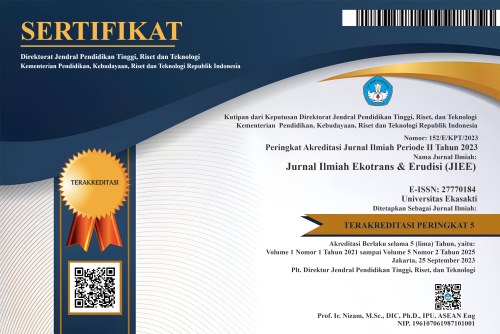
Accreditation and Certificate
Jurnal Ilmiah Ekotrans & Erudisi (JIEE) is committed to maintaining the accuracy, reliability, transparency, permanence, and integrity of the scholarly record. The journal recognizes that errors, omissions, methodological concerns, ethical issues, and questions regarding research reliability may be identified after an article has been published.
JIEE considers the responsible correction of published literature an essential component of scholarly publishing. The journal is committed to addressing credible post-publication concerns through fair, transparent, evidence-based, and proportionate editorial procedures.
This policy establishes the principles, criteria, responsibilities, and procedures governing Corrections, Errata, Corrigenda, Addenda, Expressions of Concern, Retractions, Article Withdrawal, and exceptional Content Removal.
The policy is informed by the Committee on Publication Ethics (COPE) Retraction Guidelines, reviewed in August 2025, relevant COPE guidance concerning publication integrity, and the recommendations of Crossref for recording corrections, retractions, and other significant updates to scholarly publications.
The primary purpose of editorial correction and retraction is to maintain the accuracy and integrity of the scientific literature, protect readers from relying on unreliable information, and preserve an accurate historical record of scholarly communication. Such measures are not intended primarily as disciplinary sanctions against authors.
This policy establishes a consistent framework for evaluating and responding to significant concerns affecting articles published in JIEE.
The specific objectives are to:
This policy applies to all scholarly content published by JIEE, including research articles, review articles, conceptual and theoretical contributions, and other article types formally approved by the journal.
The policy covers concerns raised by:
The journal may consider concerns involving previously published articles regardless of the time elapsed since publication, subject to the availability of relevant evidence and applicable legal or institutional requirements.
The appropriate editorial response must depend on the nature of the concern, its consequences for the reliability of the article, and the evidence available.
JIEE adopts the following principles when handling published material that may require correction or other editorial action.
Published information must represent research evidence and scientific conclusions accurately. Material inaccuracies should be corrected through transparent procedures.
Significant editorial changes must be communicated through an identifiable notice explaining the nature of the action.
The response must reflect the seriousness of the problem and its effect on the reliability and interpretation of the published research.
Authors and other relevant parties should ordinarily have a reasonable opportunity to provide explanations or supporting documentation before a significant adverse editorial decision is finalized.
Editorial decisions must not be influenced by financial, personal, institutional, political, or other inappropriate interests.
Published articles and their correction or retraction history should ordinarily remain traceable as part of the permanent scholarly record.
Credible concerns should be assessed without unnecessary delay. The journal must balance timely action with the need for sufficient evidence and procedural fairness.
Significant editorial decisions should be supported by documented reasoning, appropriate records, and compliance with the journal's approved procedures.
JIEE distinguishes among several types of editorial action according to the nature and significance of the issue identified.
Minor corrections involve typographical, formatting, or technical issues that do not materially affect the scientific meaning, interpretation, attribution, or reliability of an article.
Examples include:
Minor changes may be corrected directly where appropriate, provided that the journal maintains sufficient administrative records and does not obscure changes that materially affect bibliographic information or scholarly interpretation.
Changes to author identity, authorship, scientific results, interpretations, or other substantive information must not be treated automatically as minor corrections.
A Correction is an official notice addressing an identifiable error or omission in a published article when the principal research findings and conclusions remain sufficiently reliable.
Corrections may concern:
The correction notice should identify the original article, describe the error, explain the necessary amendment, and clarify whether the correction affects the principal findings or conclusions.
An Erratum ordinarily refers to a correction involving an error introduced during editorial processing, copyediting, typesetting, production, or publication.
Examples may include incorrect figure placement, a production-related omission, or an error introduced into the final publication file.
The journal may use the general designation "Correction" instead of "Erratum" where this provides greater clarity and consistency.
A Corrigendum ordinarily refers to an author-originated correction involving an error identified after publication that does not require retraction of the article.
Examples may include a reporting error, an omitted methodological detail, or an incorrect numerical value supplied by the authors.
Whether the notice is called a Corrigendum or Correction, its content must explain the issue transparently and identify its implications for the published work.
An Addendum provides supplementary clarification or important information relating to a published article without replacing its original research findings.
An addendum may be appropriate when relevant additional information is necessary to understand the publication, provided that the supplementary information does not conceal an error requiring correction or an integrity concern requiring investigation.
An addendum must not be used to introduce fundamentally new research under the appearance of a minor update.
An Expression of Concern is a formal editorial notice informing readers that substantial questions have arisen concerning a published article, but sufficient evidence is not yet available to determine whether correction or retraction is warranted.
An Expression of Concern may be considered when:
An Expression of Concern does not constitute a finding that the authors committed misconduct.
The notice should describe the concern carefully, avoid unsupported allegations, and explain the status of the matter to the extent permitted by confidentiality and applicable requirements.
When additional evidence becomes available, the journal should review whether the Expression of Concern should be updated, followed by a correction or retraction, or accompanied by a notice explaining that the concern has been resolved.
A Retraction is a formal editorial action indicating that a published article should no longer be relied upon as a valid contribution to the scholarly record in its retracted form.
Retraction may be appropriate when the findings or conclusions are seriously unreliable or when significant publication integrity violations compromise the legitimacy of the published work.
The primary objective of retraction is to correct the scholarly record and alert readers to the limitations or unreliability of the publication.
Retraction must not be used merely to punish authors, suppress legitimate academic disagreement, or remove an article because its conclusions are controversial.
JIEE may consider retracting an article when sufficiently reliable evidence supports one or more of the following circumstances.
The article contains substantially unreliable findings arising from serious methodological errors, analytical problems, data irregularities, or other circumstances that invalidate the principal conclusions.
Research data, observations, participants, interviews, documents, or results have been fabricated or materially falsified, compromising the reliability of the publication.
The article contains substantial plagiarism or intellectual misappropriation that cannot be adequately resolved through a limited correction.
The article substantially duplicates previously published work without appropriate disclosure or legitimate scholarly justification, and the duplication warrants correction of the publication record.
The article was accepted through materially compromised peer review, such as fabricated reviewer identities, manipulated review reports, or other serious interference with independent editorial evaluation.
The research involved substantial ethical violations that undermine the acceptability or reliability of the published work, including serious breaches of applicable human research protections or unauthorized use of sensitive research materials.
Other serious violations, including deliberate misrepresentation of research evidence or publication circumstances, may justify retraction when their consequences for the integrity of the scholarly record cannot be adequately addressed through a correction or another less extensive measure.
A retraction decision must be based on the nature of the evidence and its consequences for the publication. An allegation alone does not establish grounds for retraction.
Retraction is not automatically justified by every identified error, ethical concern, or disagreement.
The following circumstances require contextual assessment:
In such cases, correction, clarification, additional scholarly discussion, or another proportionate editorial action may be more appropriate than retraction.
JIEE distinguishes withdrawal of an unpublished manuscript from retraction of a formally published article.
An author may request withdrawal of a manuscript before publication by submitting a written explanation to the editorial office.
Withdrawal requests should identify the manuscript and explain the reason for the request.
The corresponding author should confirm that the other authors have been informed and have agreed to the withdrawal, where appropriate.
Requests may arise because of substantial errors, ethical concerns, inability to complete necessary revisions, authorship disputes, or other legitimate circumstances.
The editorial team should review the request and document the outcome in the manuscript management system.
Withdrawal of an unpublished submission does not automatically establish misconduct.
Once an article has been formally published online as part of the scholarly record, including an online-first version of record, withdrawal of an unpublished manuscript is no longer the appropriate procedure. Post-publication corrections, retractions, or other formal notices must then be considered.
A concern or request may be initiated by:
Reports should be submitted through the journal's official editorial contact channel:
JIEE Editorial Office and Contact Information.
For identification purposes, correspondence should preferably use the subject line:
Request for Correction or Retraction – [Article Title or DOI]
The request should include, where available:
Anonymous reports may be considered when they provide sufficiently specific, credible, and verifiable information.
JIEE adopts a structured procedure for evaluating concerns that may require correction, an Expression of Concern, or retraction.
The editorial office receives the report, identifies the article concerned, records the nature of the issue, and preserves relevant supporting materials.
The Editor-in-Chief or another appropriately authorized editor evaluates whether the concern appears credible, is sufficiently specific, and falls within the journal's publication responsibilities.
The assessment should identify any relevant conflicts of interest among the editorial personnel involved.
The editor considers whether the issue involves a minor technical error, a substantive but correctable mistake, unresolved reliability concerns, or evidence suggesting serious research or publication misconduct.
Where appropriate, the editorial office contacts the corresponding author and requests a response addressing the specific concerns.
Additional documentation, original research data, corrected analyses, ethical approval information, or other supporting materials may be requested.
Where necessary, the journal may seek advice from independent methodological, statistical, disciplinary, or research integrity experts.
The assessment must be conducted by individuals without relevant conflicts of interest.
When a concern requires formal investigation of research conduct, the journal may refer relevant evidence to the appropriate institution or research integrity office.
The journal is responsible for publication-related decisions but does not ordinarily replace the institution's responsibility to investigate researcher conduct.
After evaluating the evidence, responses, and relevant expert or institutional information, the responsible editor determines the appropriate action.
Possible outcomes include closure without corrective action, a minor technical amendment, formal correction, addendum, Expression of Concern, retraction, or another appropriate measure.
The journal communicates the proposed or final editorial action to the relevant authors, providing an opportunity to identify factual inaccuracies in a proposed notice where appropriate.
Author approval is not necessarily required for a justified editorial correction or retraction when the journal has sufficient evidence to proceed in accordance with its responsibilities.
Where a formal notice is required, the journal publishes an appropriately titled and dated notice that identifies the article and explains the editorial action.
The journal updates the article landing page and relevant publication records, links the notice to the original publication, and submits applicable metadata updates to its DOI registration service where technically supported.
The editorial office maintains appropriate records of the assessment, communications, evidence, decisions, and resulting changes to the scholarly record.
Authors are responsible for promptly notifying the editorial office when they discover significant errors or reliability concerns in their published research.
Authors must cooperate with reasonable requests for clarification, corrected analyses, research documentation, and other information needed to assess a concern.
Authors should be given a fair opportunity to explain relevant circumstances before significant adverse editorial decisions are finalized.
Where authors disagree with the proposed action, their response should be considered objectively and documented appropriately.
However, scientific disagreement or refusal to consent does not automatically prevent the editor from issuing a justified correction or retraction.
Where a retraction notice is issued, the notice should accurately distinguish the authors who agree or disagree with the retraction when such information is material, appropriate, and supported by the available record.
Authors must not conceal known errors, provide fabricated supporting documentation, or obstruct reasonable editorial assessment.
Retraction may be initiated by the authors when they identify serious problems affecting the reliability or integrity of their published article.
Authors requesting retraction should provide an explanation and relevant supporting evidence to the editorial office.
Retraction may also be initiated by the journal when credible evidence demonstrates that a publication meets the applicable retraction criteria.
The journal may proceed with a justified retraction after an appropriate assessment even when the authors disagree with the decision or do not respond to reasonable requests for clarification.
The decision must be based on evidence, editorial responsibility, and the need to protect the scholarly record rather than personal disagreement or punitive objectives.
A formal Correction, Erratum, or Corrigendum should contain sufficient information for readers to understand the change and locate the original article.
The notice should ordinarily include:
Where an updated publication file is provided, the journal should clearly identify the corrected version and preserve an appropriate record of the substantive amendment.
Important scientific corrections must not be implemented solely through unannounced replacement of the original article file.
An Expression of Concern must be clearly distinguished from a correction or retraction.
The notice should:
Where concerns are subsequently resolved, JIEE should provide an appropriate public clarification or update so that readers can understand the outcome.
An Expression of Concern should not remain misleadingly unresolved when the journal has received sufficient information to determine the appropriate next action.
Every formal retraction must be accompanied by a clear and publicly accessible retraction notice.
The notice should ordinarily include:
The language of the notice must be factual, accurate, proportionate, and free from unsupported accusations.
Where the evidence demonstrates unreliability but does not establish intentional misconduct, the notice should not imply that intentional misconduct has been proven.
Retraction notices must remain freely accessible to readers.
JIEE recognizes that retracted articles ordinarily remain part of the historical scholarly record.
Accordingly, the original publication should normally remain accessible, subject to appropriate notices and clear identification of its retracted status.
The journal should take reasonable steps to ensure that:
The original article must not simply disappear from the journal website without an appropriate public explanation.
A retracted article should not be silently replaced with a materially different manuscript that appears to be the original version of record.
JIEE recognizes the importance of accurate DOI information and persistent links in communicating changes to published research.
When a significant post-publication action is taken, the editorial office should evaluate the metadata updates required to reflect the current status of the article.
The original article DOI should remain associated with its established scholarly record. Registered DOI identifiers are persistent and should not be arbitrarily deleted or reassigned to unrelated content.
Where supported by the journal's DOI registration arrangements, substantive correction and retraction notices should be registered as separate scholarly records with their own DOI identifiers.
The relationship between an original article and its correction or retraction notice should be recorded using applicable Crossref update metadata where supported.
The journal should also update the article's landing page and relevant bibliographic information to communicate the status of the publication.
JIEE may use Crossref's available update registration mechanisms without claiming participation in Crossmark unless Crossmark has actually been implemented by the journal.
When Crossmark is formally implemented, its required update policies, metadata registration, and presentation requirements should be followed consistently.
Metadata updates should be verified after submission to ensure that the corresponding article and notice remain discoverable and appropriately linked.
JIEE is committed to maintaining a transparent distinction between the original version of record and significant subsequent changes.
Minor technical corrections that do not affect scholarly meaning may be implemented directly where appropriate.
Material changes affecting scientific results, interpretation, attribution, or research reliability should ordinarily be accompanied by a separate editorial notice or clearly documented publication update.
When a corrected PDF or other publication file is made available, the editorial office should ensure that readers can identify that a substantive correction has occurred.
Where appropriate, information concerning the publication date, correction date, notice type, and relationship between versions should be retained.
JIEE should not use an updated version to conceal the existence of significant problems in an earlier published version.
In exceptional circumstances, only a clearly identifiable part of a publication may be affected by an issue requiring formal editorial action.
The journal may consider a partial retraction or another appropriately identified notice only when the affected content can be distinguished clearly and readers are not misled concerning the reliability of the remaining article.
Where the principal results or overall conclusions are compromised, retraction of the publication as a whole may be more appropriate.
Retraction with replacement must not be treated as a routine substitute for transparent correction or retraction.
If a replacement publication is justified in exceptional circumstances, the journal must provide a clear explanation, preserve the history of the original publication, and establish appropriate relationships between the original and replacement records.
The editorial team should consider applicable COPE guidance before adopting such an approach.
JIEE distinguishes retraction from the physical removal of published content.
Retraction ordinarily preserves the original publication with a clearly identifiable notice.
Complete removal or restricted access to published content should be considered only under exceptional circumstances, such as:
Where removal is unavoidable, the journal should, to the extent lawful and appropriate, preserve a publicly accessible bibliographic record explaining that the content has been removed and providing a suitable reason for the action.
Removal must not be used merely to conceal research misconduct, criticism, or errors in editorial judgment.
Authors or other relevant parties who believe that a correction, Expression of Concern, or retraction decision was based on a significant factual or procedural error may request reconsideration.
A request should provide:
Where practicable, reconsideration should be assigned to an appropriately authorized editor or independent individual without a relevant conflict of interest.
The journal may seek further expert advice when a case involves substantial methodological, scientific, or ethical questions.
An appeal does not automatically suspend publication of a necessary notice or guarantee reversal of the editorial action.
Where the available evidence materially changes, the journal may revise the notice or issue an appropriate further statement explaining the outcome.
Editors handling post-publication concerns must disclose relevant competing interests and withdraw from cases where their impartiality could reasonably be questioned.
Examples include concerns involving:
Where the Editor-in-Chief or another responsible editorial officer has a significant conflict of interest, the matter should be reassigned to an appropriately authorized independent editor or representative.
Institutional authority, author reputation, publication charges, journal ranking considerations, and other external pressures must not determine whether an article is corrected or retracted.
Serious allegations involving possible fabrication, falsification, plagiarism, or other research misconduct may require formal investigation by an appropriate institution or research integrity authority.
JIEE may provide relevant documentation and cooperate with authorized investigations in accordance with applicable confidentiality and legal requirements.
The journal may consider institutional findings when determining whether published content remains reliable.
However, JIEE retains responsibility for making appropriate publication-related decisions concerning its own scholarly record.
An institutional investigation and editorial assessment serve related but distinct purposes.
Where a formal institutional investigation is delayed, unavailable, or inconclusive, the journal should assess whether the evidence already available justifies an Expression of Concern or other proportionate editorial action.
A completed institutional misconduct finding is not always a prerequisite for correcting or retracting an article when the available evidence adequately demonstrates serious unreliability.
JIEE aims to assess credible post-publication concerns promptly and without unnecessary delay.
The time required to resolve a concern may vary according to the complexity of the evidence, the availability of authors, the need for specialist evaluation, and the involvement of relevant institutions.
The editorial office should communicate with relevant parties at appropriate stages of the process and avoid allowing significant concerns to remain unresolved without reasonable justification.
Where important reliability concerns cannot be resolved promptly, the journal should consider whether an interim Expression of Concern is necessary to inform readers.
Formal notices should be published as soon as reasonably practicable after the journal reaches a sufficiently supported editorial determination.
JIEE respects the confidentiality of individuals involved in post-publication assessments, including authors, reviewers, complainants, and research participants.
Confidential information should be disclosed only to persons or institutions whose involvement is reasonably necessary for the assessment or resolution of the matter.
Individuals who report credible concerns in good faith must not be subjected to inappropriate retaliation or intimidation through the editorial process.
Anonymous reports may be considered when they contain sufficient evidence for meaningful assessment.
Confidentiality must be balanced with the journal's obligation to provide transparent explanations of significant changes to published scholarly content.
Public notices should disclose sufficient information to explain the editorial action without unnecessarily exposing private information or making unsupported personal accusations.
The JIEE editorial office should maintain appropriate records concerning significant corrections, expressions of concern, retractions, and related inquiries.
Such records may include:
Records should be retained securely and managed in accordance with applicable institutional procedures and privacy requirements.
Appropriate documentation supports transparency, consistency, and accountability in editorial practice.
Authors are responsible for reporting significant errors in their published work, providing relevant supporting information, responding to credible concerns, and cooperating with justified corrective actions.
The responsible editors are accountable for assessing publication concerns fairly, selecting appropriate actions, seeking independent expertise where necessary, and ensuring that significant editorial decisions are supported by relevant evidence.
The Managing Editor supports communication, documentation, OJS processing, publication of notices, article record updates, and coordination of technical and administrative implementation.
Universitas Ekasakti, as the institutional publisher associated with JIEE, supports the journal in maintaining an accurate scholarly record and providing appropriate institutional cooperation when significant publication integrity concerns arise.
The publisher must respect the independence of scientific editorial decisions.
This Correction and Retraction Policy forms part of the journal's integrated framework for research integrity and responsible scholarly publishing.
It should be read in conjunction with the following existing journal pages:
The journal should also maintain consistency with its dedicated policies concerning authorship, research misconduct, competing interests, and post-publication discussion once those policies have been formally adopted and published.
The principles established in this policy are informed by internationally recognized guidance on corrections, retractions, editorial transparency, and the maintenance of scholarly publication records.
This Correction and Retraction Policy establishes the journal's framework for maintaining the integrity of its scholarly publication record through proportionate, transparent, and evidence-based editorial actions.
The policy becomes effective following formal approval and publication by the responsible JIEE editorial management.
The journal should periodically review this policy to maintain consistency with current COPE guidance, Crossref metadata practices, applicable institutional requirements, and developments in responsible scholarly publishing.
Material changes should be communicated transparently through the official journal website.
JIEE is committed to ensuring that significant corrections, expressions of concern, and retractions are handled fairly and communicated clearly so that readers can determine the current status and reliability of published scholarly content.
Accreditation and Certificate
Template


Support By


Tools