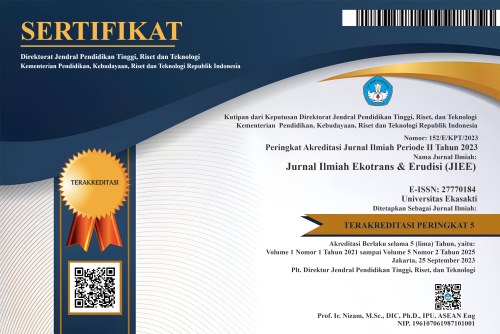
Accreditation and Certificate
Jurnal Ilmiah Ekotrans & Erudisi (JIEE) is committed to maintaining editorial independence, scholarly integrity, transparency, and accountability in all matters concerning advertising, institutional sponsorship, and promotional communication.
JIEE recognizes that appropriate scholarly announcements may help disseminate information about academic events, research opportunities, scientific publications, and professional development activities. However, advertising and promotional arrangements must remain separate from manuscript evaluation, peer review, editorial decision-making, and the presentation of published research.
This Advertising Policy establishes the journal's principles, eligibility requirements, approval procedures, placement restrictions, disclosure standards, and responsibilities relating to advertising and sponsorship.
JIEE may consider advertising and promotional announcements that are relevant to its scholarly scope and academic readership, subject to prior assessment and approval by the responsible editorial management.
The journal does not guarantee acceptance of advertising proposals. Each proposal must satisfy the standards established in this policy.
Advertising eligibility is limited to legitimate scholarly, educational, research-related, or professional activities that are consistent with the journal's academic mission.
Acceptance of advertising does not constitute scientific endorsement of the advertised organization, product, service, event, or activity.
Advertising, sponsorship, and other promotional arrangements must not influence editorial decision-making.
Manuscripts submitted to JIEE are evaluated on the basis of scholarly relevance, originality, methodological rigor, analytical quality, ethical compliance, and the journal's editorial standards.
Advertisers and sponsors shall have no authority to:
The existence or absence of an advertising relationship must not affect the journal's editorial treatment of authors or manuscripts.
Responsibility for approving or rejecting advertising proposals rests with the Editor-in-Chief, or another appropriately authorized representative where necessary.
The responsible decision-maker may consult relevant editorial or institutional personnel concerning the suitability, legality, technical presentation, and potential conflicts of interest associated with an advertisement.
Advertising decisions must be separated from the scientific evaluation of manuscripts.
Where the Editor-in-Chief has a relevant conflict of interest, the proposal should be referred to another appropriately authorized and independent representative.
Advertising proposals may be rejected when they are inconsistent with the journal's academic objectives, ethical standards, institutional responsibilities, or applicable legal requirements.
JIEE may consider the following categories of scholarly or professional advertising:
Proposals involving research or publishing services may receive additional scrutiny to ensure that they do not promote deceptive publishing practices, fabricated research services, manuscript sales, authorship brokerage, or unethical publication arrangements.
JIEE does not accept advertisements that:
The journal reserves the right to reject or withdraw advertising that violates these requirements.
Approved advertisements, where displayed, must be clearly distinguished from scholarly publications and the journal's editorial content.
Advertisements may appear only in designated promotional areas of the journal website or other specifically approved communication channels.
Such areas may include appropriate information panels, institutional announcement pages, or designated website locations that do not interfere with the interpretation of published research.
Advertising must not be incorporated into the substantive text, abstracts, references, research figures, or conclusions of peer-reviewed scholarly articles.
Advertisements must not obscure essential publication information or prevent readers from accessing journal content.
The placement of advertisements must not suggest that advertised activities or organizations have received special scholarly endorsement from JIEE.
JIEE adopts a non-behavioral approach to advertising.
Advertising proposals are considered according to their general relevance to the journal's disciplinary scope and academic readership.
Approved advertisements are not selected on the basis of individual readers' browsing histories, personal profiles, manuscript downloads, search histories, or other behavioral tracking information.
The journal does not authorize personalized advertising based on sensitive personal data or confidential manuscript information.
Advertising is not selected to favor, suppress, or respond to the findings of specific published articles.
Where approved advertisements are displayed, their placement is determined through editorially authorized website arrangements rather than individual behavioral targeting.
Any future introduction of contextual, automated, or personalized advertising would require prior institutional and editorial assessment, compliance with applicable privacy requirements, and an appropriate public revision of this policy.
All approved advertisements must be clearly and accurately identified so that readers can distinguish promotional materials from independent scholarly content.
Appropriate labels may include:
Advertisements must not imitate the appearance of accepted journal articles, peer review reports, editorial decisions, or other scholarly materials in a manner that could mislead readers.
The identity of the advertiser or sponsor should be disclosed where relevant and appropriate.
JIEE does not permit undisclosed paid editorial content to be presented as independently peer-reviewed scientific research.
Institutional sponsorship refers to financial or non-financial support provided for appropriate academic, organizational, or publishing-related activities.
Any sponsorship relationship must preserve the independence of scientific editorial decisions.
Sponsors must not determine manuscript acceptance, influence reviewer selection, control scholarly conclusions, or suppress legitimate academic discussion.
Where a sponsorship arrangement materially supports a specific announcement or activity, the nature of the relationship should be disclosed as appropriate.
Institutional support for journal operations must not be misrepresented as independent scientific endorsement of a particular manuscript.
Advertising or sponsorship arrangements must remain distinct from Article Processing Charges (APCs), submission procedures, and manuscript publication decisions.
Payment for advertising does not provide priority access to the peer review process or confer any entitlement to manuscript acceptance.
Advertisers must not receive preferential editorial treatment because of financial support, institutional affiliation, or promotional arrangements.
JIEE's publication fee arrangements are governed separately by its Article Processing Charge Policy.
JIEE respects the privacy of its readers, authors, reviewers, editors, and other individuals interacting with the journal's publishing platform.
Personal information collected through manuscript submission, peer review, editorial correspondence, or ordinary journal registration must not be disclosed to advertisers for behavioral targeting without an appropriate legal basis and authorization.
The journal does not authorize the use of confidential manuscript information for advertising or commercial profiling.
Any third-party advertising or tracking technology proposed for future implementation must undergo appropriate privacy, security, and institutional review before deployment.
Where cookies, analytics, or other technologies are used on the journal website, their operation must be accurately described in the applicable privacy information and comply with relevant requirements.
Readers, authors, reviewers, advertisers, and other interested parties may submit concerns regarding misleading advertisements, undisclosed sponsorship, inappropriate promotional practices, or possible interference with editorial independence.
Reports should identify the advertisement or promotional material concerned and explain the nature of the complaint.
Relevant supporting information may be requested when necessary for assessment.
Complaints may be submitted to the JIEE Editorial Office through the journal's official Contact page.
Concerns involving research or publication misconduct will be considered under the journal's applicable publication ethics procedures.
JIEE reserves the right to refuse, suspend, or withdraw an advertisement when it is inconsistent with the journal's academic mission, this Advertising Policy, applicable publication ethics standards, or relevant legal requirements.
Advertising approval may be reconsidered when new evidence indicates that an advertised service, institution, activity, or claim is misleading, unlawful, or ethically inappropriate.
Where a serious conflict of interest is identified, the journal may discontinue the relevant advertising arrangement to protect editorial independence.
Such decisions should be supported by reasonable and documented justification.
This Advertising Policy complements the journal's framework for editorial independence, publishing transparency, financial accountability, research integrity, and responsible scholarly communication.
Relevant journal policies include:
This policy is informed by the principles of editorial independence and transparent business practices established in the Principles of Transparency and Best Practice in Scholarly Publishing, developed jointly by the Committee on Publication Ethics (COPE), Directory of Open Access Journals (DOAJ), Open Access Scholarly Publishing Association (OASPA), and World Association of Medical Editors (WAME).
Principles of Transparency and Best Practice in Scholarly Publishing.
Reference to these principles does not imply formal membership, certification, or endorsement by the organizations concerned.
This Advertising Policy establishes the journal's framework for assessing scholarly advertisements and sponsorships while protecting independent editorial decision-making.
The policy becomes effective following formal approval and publication by the responsible JIEE editorial management.
The journal should periodically review this policy to maintain consistency with its actual advertising arrangements, applicable privacy obligations, publication ethics standards, and institutional requirements.
Material changes in advertising acceptance, selection, targeting, or sponsorship arrangements should be communicated transparently through the official journal website.
JIEE maintains that scholarly merit, research integrity, and independent editorial judgment must take precedence over all commercial or promotional interests.
Accreditation and Certificate
Template


Support By


Tools