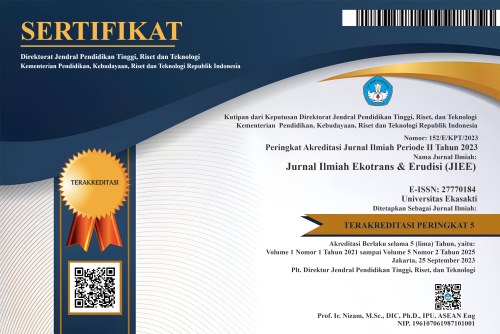
Accreditation and Certificate
Jurnal Ilmiah Ekotrans & Erudisi (JIEE) is committed to transparent scholarly copyright and licensing arrangements that protect author rights while enabling broad access, dissemination, and lawful reuse of published scientific knowledge.
This Licensing Policy explains the public license applied to JIEE articles, the ownership of copyright, the publishing rights granted to the journal, the rights and obligations of readers and other users, and the conditions governing reproduction, adaptation, translation, distribution, and repository deposits.
JIEE applies the Creative Commons Attribution-ShareAlike 4.0 International License (CC BY-SA 4.0) to articles published under its stated open-access publishing terms.
The official license is available at https://creativecommons.org/licenses/by-sa/4.0/.
The Creative Commons Attribution-ShareAlike 4.0 International License permits users to share and adapt licensed works for any purpose, including commercial purposes, subject to the attribution and ShareAlike requirements established by the license.
The main features of CC BY-SA 4.0 are:
The official Creative Commons legal code governs the interpretation and application of the license. This journal policy provides an explanatory summary and does not replace or modify the Creative Commons license.
Authors retain copyright over their original scholarly works published in JIEE.
Publication in JIEE does not ordinarily require authors to transfer exclusive copyright ownership to the journal or publisher.
Authors grant JIEE the right of first publication and the non-exclusive permissions necessary to publish, disseminate, identify, and maintain the scholarly work under the agreed publishing arrangements.
Authors remain responsible for ensuring that they hold the necessary rights to the materials included in their manuscripts or have obtained appropriate permission for their inclusion.
Where copyright is held jointly with an employer, institution, or another rights holder, authors must ensure that the publication agreement and public licensing arrangement are authorized.
By agreeing to publish an accepted manuscript in JIEE, authors authorize the journal to make the work available as its official scholarly publication.
The right of first publication establishes JIEE as the original journal source of the published article and supports the maintenance of its bibliographic information and version of record.
This publishing right does not prevent authors from exercising rights retained under the applicable non-exclusive agreement and Creative Commons license.
Any subsequent republication or distribution should acknowledge the article's initial publication in JIEE.
Under CC BY-SA 4.0, users may exercise the following rights in relation to licensed material:
Users do not need to obtain additional permission from JIEE for activities already authorized by CC BY-SA 4.0, provided they comply with its requirements and the material concerned is covered by that license.
Anyone sharing or adapting JIEE material under CC BY-SA 4.0 must provide appropriate attribution.
Where supplied, attribution should retain the following information:
Attribution must not imply that the original authors, the journal, or the publisher endorse the subsequent use or adaptation.
The following is an illustrative attribution format:
This material is adapted from [Author(s)], "[Article Title]," published in Jurnal Ilmiah Ekotrans & Erudisi, [Year], [DOI]. Licensed under Creative Commons Attribution-ShareAlike 4.0 International (CC BY-SA 4.0). Changes were made to the original material.
Users should replace the bracketed information with the relevant bibliographic details and provide links where reasonably practicable.
The ShareAlike provision applies when an individual creates adapted material covered by the license and shares that adaptation with others.
Examples of adaptations may include:
When such adapted material is shared, the adapter must comply with the CC BY-SA 4.0 license requirements, including the applicable ShareAlike licensing conditions.
The adapter's contributions must be licensed under CC BY-SA 4.0 or a license permitted under the relevant compatibility provisions.
Users must also identify the original work, provide appropriate attribution, link to the license, and indicate that modifications have been made.
The ShareAlike requirement does not automatically extend to independently created works merely because they cite or discuss a JIEE article.
CC BY-SA 4.0 permits commercial use of licensed material.
Commercial reuse may include the redistribution, incorporation, or adaptation of licensed content in products, services, educational materials, or publications distributed in a commercial context.
Such activities remain subject to the attribution, ShareAlike, and other applicable license requirements.
JIEE does not impose a general prohibition on commercial reuse of article content that is expressly licensed under CC BY-SA 4.0.
Additional permission may be required only where a proposed activity involves rights or materials not covered by the public license, including separately licensed third-party content, trademarks, or relevant personality and privacy rights.
Users remain responsible for determining whether their intended use involves permissions beyond those granted by the Creative Commons license.
JIEE permits and encourages lawful dissemination of scholarly manuscripts through appropriate institutional and disciplinary repositories.
Authors may deposit preprint manuscripts, accepted manuscripts, and published versions of record, subject to the rights and conditions applicable to each version.
When depositing the published Version of Record, authors should:
JIEE's open-access license allows the sharing of licensed published articles without an additional copyright embargo.
Repository deposits must not imply that a preprint or unreviewed manuscript has undergone formal journal peer review.
Detailed information is available in the Archiving Policy.
The CC BY-SA 4.0 license applicable to an article does not automatically extend to material for which the authors or journal do not hold the necessary licensing rights.
Third-party material may include:
Authors must identify and appropriately acknowledge third-party content and obtain necessary permissions when required.
Where third-party material is excluded from the article's CC BY-SA 4.0 license, its separate rights or conditions should be clearly indicated in the publication.
Readers who wish to reuse excluded material must comply with the applicable rights and permissions.
JIEE seeks to ensure that the copyright holder and applicable public license are identifiable on its website and within published scholarly articles.
Article landing pages and publication files should provide or clearly reference relevant licensing information.
Where appropriate, a published article may include the following standard statement:
Copyright: © [Year] The Author(s). The authors retain copyright and grant Jurnal Ilmiah Ekotrans & Erudisi the right of first publication. This article is distributed under the Creative Commons Attribution-ShareAlike 4.0 International License (CC BY-SA 4.0): https://creativecommons.org/licenses/by-sa/4.0/.
Any material excluded from the license must be identified separately.
The journal should seek consistency between the license information displayed on the article landing page, the published PDF, and the metadata supplied to relevant scholarly registration and indexing services.
Accurate publication metadata supports the discoverability, accessibility, and lawful reuse of scholarly content.
Where supported by the journal's publishing platform and metadata registration arrangements, JIEE should include appropriate license information in article metadata.
Such information may include:
The journal should maintain consistency between human-readable license statements and machine-readable metadata where technically supported.
License metadata must reflect the actual terms applicable to the publication and must not be used to imply rights that have not been granted.
Any future change in the journal's standard licensing arrangement must be approved by the responsible editorial and publishing authorities and communicated transparently through the official journal website.
Changes must not be presented as automatically replacing the valid licensing terms previously granted for published articles.
Articles published under CC BY-SA 4.0 remain subject to that public license in accordance with its terms, provided that users comply with the applicable requirements.
Where articles are published under different licensing arrangements, the applicable license must be identified individually and accurately.
Policy updates must not create misleading statements regarding the copyright or reuse rights attached to the existing scholarly record.
Authors, rights holders, readers, and other interested parties may report concerns relating to unauthorized reproduction, inappropriate attribution, incorrect license information, or other potential intellectual property issues.
Reports should be submitted to the JIEE Editorial Office through its official Contact page.
A report should identify the article or material concerned, describe the relevant copyright or licensing issue, and provide supporting information where available.
The editorial team may request clarification from the relevant parties and determine whether a correction, clarification, additional permission, or other appropriate action is necessary.
Licensing concerns that also involve substantial research integrity problems may be assessed under the journal's applicable publication ethics and correction procedures.
This Licensing Policy should be read together with the following publicly available policies:
The rights and responsibilities described in these policies should be interpreted consistently with the applicable Creative Commons legal code and relevant copyright law.
This Licensing Policy establishes the journal's intended framework for copyright retention, non-exclusive publishing rights, Creative Commons licensing, lawful reuse, adaptation, and repository dissemination.
The policy becomes effective following formal approval and publication by the responsible JIEE editorial management.
The journal should periodically review its licensing statements and operational practices to ensure consistency between journal-level policies, article-level copyright notices, published files, and applicable publication metadata.
JIEE supports transparent and responsible scholarly reuse while safeguarding author attribution, applicable third-party rights, and the integrity of its published research.
Accreditation and Certificate
Template

Support By


Tools