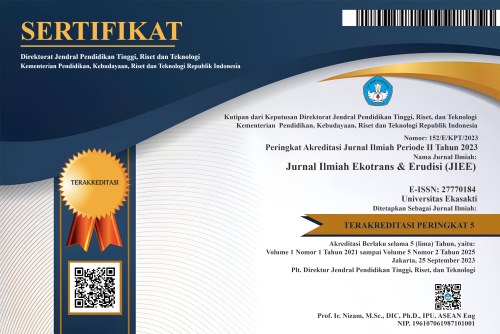
Accreditation and Certificate
Jurnal Ilmiah Ekotrans & Erudisi (JIEE) is committed to promoting open, constructive, evidence-based, and responsible scholarly communication beyond the initial publication of research articles. The journal recognizes that publication is not the final stage of scientific inquiry but an important contribution to an ongoing process of critical evaluation, scholarly debate, verification, and knowledge development.
JIEE encourages readers, researchers, authors, and members of the academic community to engage critically with published research through appropriate scholarly channels. Constructive post-publication discussion helps clarify scientific interpretations, identify methodological limitations, recognize alternative explanations, correct inaccuracies, and advance theoretical and empirical understanding.
This policy establishes the journal's framework for submitting, evaluating, facilitating, and documenting scholarly discussions concerning previously published articles. It also explains the relationship between post-publication debate, author responses, editorial clarification, corrections, expressions of concern, and retractions.
The policy is informed by the guidance of the Committee on Publication Ethics (COPE) and the Principles of Transparency and Best Practice in Scholarly Publishing developed by COPE, the Directory of Open Access Journals (DOAJ), the Open Access Scholarly Publishing Association (OASPA), and the World Association of Medical Editors (WAME).
The primary objective of the Post-Publication Discussion Policy is to facilitate scholarly engagement with published research while protecting the accuracy, credibility, and integrity of the scientific record.
Specifically, this policy aims to:
This policy applies to scholarly discussions, comments, critiques, and concerns relating to articles published in JIEE.
Post-publication discussions may address theoretical, methodological, empirical, analytical, interpretative, ethical, or policy-related aspects of published research.
Relevant subjects include:
Scholarly criticism must focus on the research, published evidence, analytical arguments, or scientific conclusions rather than the personal characteristics of the authors.
JIEE recognizes several forms of post-publication scholarly communication. The appropriate format depends on the nature, significance, and complexity of the matter raised.
A Letter to the Editor is a formal scholarly communication addressing specific aspects of an article previously published in JIEE.
Letters may identify methodological concerns, question the interpretation of results, discuss alternative explanations, highlight relevant overlooked evidence, or request clarification of a substantive scientific issue.
Letters should identify the original article, present a clear and focused argument, and provide sufficient evidence or references to support the concern.
Letters that make a meaningful contribution to scholarly discussion may be considered for publication, subject to editorial assessment and any additional review considered necessary.
Scholarly comments and critical commentaries provide more developed assessments of published research.
Such contributions may discuss the strengths and limitations of a theoretical framework, evaluate methodological assumptions, compare findings with other studies, or identify broader implications for public administration, governance, public policy, and related social sciences.
Comments must demonstrate analytical relevance, academic rigor, appropriate citation practices, and a constructive contribution to scientific understanding.
Authors of the original article may be invited to respond to relevant scholarly criticisms or requests for clarification.
An author response may explain the research design, clarify analytical procedures, provide additional interpretation, address identified limitations, or explain why a criticism does not invalidate the original conclusions.
Responses should engage directly with the substantive issues raised and must remain professional, evidence-based, and respectful.
Where necessary, the editorial team may provide a clarification concerning the published article, relevant editorial procedures, or the status of an issue raised after publication.
Editorial clarification must not be used to conceal substantive errors or replace a formal correction, expression of concern, or retraction when such action is warranted.
Where post-publication discussion identifies a significant error or reliability concern, the matter may require action under the journal's applicable correction and retraction procedures.
Such action may include a correction notice, an Expression of Concern, a retraction, or another appropriate editorial notice depending on the nature and seriousness of the issue.
Readers, researchers, authors, and other members of the scholarly community may submit post-publication comments or concerns through the journal's official editorial contact channel.
Submissions should be directed to the JIEE Editorial Office using the contact information provided on the journal's Contact page.
For ease of identification, the correspondence should use the subject line:
Post-Publication Discussion – [Article Title or DOI]
A formal submission should include:
Submissions should be sufficiently clear and focused to allow meaningful editorial assessment and, where appropriate, a response from the original authors.
The editorial office may request revisions, additional information, or a more concise presentation before considering a submission for formal publication.
JIEE welcomes constructive academic criticism and recognizes that disagreement is a normal and valuable component of scientific development.
All post-publication discussions must comply with the following principles:
Critical discussion does not need to support the original article's conclusions. The journal welcomes scientifically justified disagreement, including arguments that challenge published interpretations or identify potentially important limitations.
All formal post-publication submissions are subject to an initial assessment by the Editor-in-Chief or another appropriately designated editor.
The initial evaluation considers:
Submissions that contain personal attacks, defamatory statements, knowingly misleading information, substantial unsupported accusations, or irrelevant material may be declined or returned for revision.
Editorial rejection of a proposed commentary does not necessarily mean that the underlying scientific concern has been dismissed. Where a credible integrity issue is identified, the journal should consider the concern under the appropriate editorial or publication ethics procedure.
Formal critiques considered for publication may undergo editorial evaluation and, where warranted, independent peer review.
The level of review should be proportionate to the content and complexity of the submission.
A brief request for factual clarification may require editorial assessment, whereas a complex methodological criticism, statistical reanalysis, or substantial challenge to published findings may require independent specialist review.
Editors and reviewers involved in assessing the discussion must disclose relevant conflicts of interest.
Individuals with significant relationships to the original authors or the contributors submitting the critique should not participate in an assessment where their independence could reasonably be questioned.
The responsible editor may request revisions to improve clarity, accuracy, evidentiary support, or academic tone.
Publication decisions regarding formal commentary remain the responsibility of the authorized editorial team.
When a substantive critique is considered suitable for further editorial evaluation or publication, the journal will ordinarily provide the authors of the original article with an opportunity to respond.
The editorial office should communicate the relevant concerns clearly and provide a reasonable response period appropriate to the complexity of the matter.
The authors' response may include:
The original authors are expected to respond professionally and address the substance of the critique rather than the personal identity or motivations of its contributor.
The editorial team may assess the response for relevance, clarity, scientific accuracy, and adherence to publication ethics.
The opportunity to respond does not provide the original authors with authority to prevent the publication of legitimate, evidence-based scholarly criticism.
If the original authors decline or fail to respond, the editorial team may continue considering the critique on its scientific merits and the evidence available.
Where a post-publication discussion is accepted for formal publication, JIEE should present it in a manner that enables readers to identify its relationship to the original article.
When appropriate, the journal may publish a Letter to the Editor or scholarly commentary together with the corresponding author response.
Formal publication arrangements should ensure that:
Where technically and editorially appropriate, formally published discussions may receive separate publication metadata and a DOI and be linked to the original article.
The assignment of a separate DOI or formal indexing status depends on the nature of the published contribution and the journal's operational and metadata capabilities.
The journal may also provide a public editorial clarification or an appropriate notice linked to the original article when this is a more suitable means of communicating the outcome.
JIEE recognizes that researchers may reasonably disagree about theoretical frameworks, methodological assumptions, analytical approaches, the interpretation of empirical evidence, and the implications of research findings.
Such differences do not automatically establish scientific error, misconduct, or grounds for retracting an article.
Where a discussion involves legitimate competing interpretations, the editorial team may facilitate constructive debate without requiring the original authors to abandon a defensible scholarly position.
Scientific disagreements should be assessed according to the relevance of the evidence, coherence of the arguments, appropriateness of the methods, and the limitations acknowledged by the parties involved.
The journal seeks to promote informed academic discussion rather than suppress disagreement or impose a single interpretation when the available evidence reasonably supports alternative conclusions.
Post-publication discussion may reveal inaccuracies that require clarification or correction of the published scientific record.
Errors may concern statistical calculations, reported numerical values, methodological descriptions, figures, tables, references, author information, or other aspects of the published article.
When an error is identified, the responsible editor should evaluate whether it:
Errors that do not invalidate the principal findings may be addressed through a correction notice or another appropriate transparent editorial action.
Significant concerns affecting the reliability of published findings must be evaluated under the journal's applicable Correction and Retraction Policy.
Where a credible post-publication concern raises substantial questions about the reliability or ethical integrity of an article, JIEE may initiate a more detailed editorial assessment.
An Expression of Concern may be appropriate when serious questions remain unresolved and the available evidence does not yet support a definitive conclusion.
A Retraction may be appropriate when reliable evidence establishes that an article's findings are substantially unreliable or that serious publication integrity problems require correction of the scholarly record.
Retraction is intended primarily to protect the scientific literature and its users rather than to punish authors.
Formal notices should identify the affected article, explain the reason for the editorial action, and remain publicly accessible.
The journal should not silently remove or materially alter published scholarly content in place of appropriate correction or retraction procedures.
Retraction decisions and the content of formal notices should be consistent with applicable COPE retraction guidance.
Post-publication discussion must be distinguished from formal allegations of research misconduct.
Scientific criticism may question the validity or interpretation of published findings without alleging deliberate wrongdoing.
Concerns involving potential fabrication, falsification, plagiarism, manipulation of research evidence, inappropriate authorship, unethical research practices, or compromised peer review should be handled under the journal's Allegations of Research Misconduct Policy.
Where such concerns arise, the journal may request clarification from the authors, seek independent expertise, evaluate supporting evidence, and cooperate with relevant research institutions when formal investigation is necessary.
The journal must avoid making unsupported public accusations against individuals. A finding of research misconduct should not be inferred solely from academic disagreement, an error, or an allegation that has not been adequately examined.
Editorial responsibility for the integrity of published content remains distinct from the institutional responsibility to investigate the professional conduct of researchers.
Scholarly discussions may also occur outside the journal website through academic conferences, research seminars, scholarly publications, institutional forums, and moderated post-publication discussion platforms.
JIEE recognizes that credible scientific concerns may originate from such external discussions.
When a relevant external concern is brought to the attention of the editorial office, the journal may assess the available evidence using the same principles applied to concerns submitted directly.
The editorial team may contact the individuals involved, request supporting documentation, seek clarification from the original authors, or initiate an appropriate editorial assessment.
The journal is not required to treat unverified online comments or anonymous accusations as established facts. However, credible and sufficiently documented concerns should not be dismissed solely because they were first raised on an external platform.
JIEE is committed to balancing transparency in scholarly communication with the protection of confidential information, personal data, and the rights of individuals involved in editorial assessment.
Post-publication discussions must not disclose confidential research participant information, unpublished data obtained without authorization, privileged peer review correspondence, or protected personal information.
Editorial correspondence relating to an ongoing investigation should remain confidential where appropriate.
Contributors must avoid defamatory statements, personal harassment, threats, discriminatory content, and unsupported allegations concerning the intentions or character of other researchers.
Where a formal discussion is published, the final text should be based on material that may lawfully and ethically be disclosed.
Individuals submitting formal critiques or author responses must disclose relevant financial and non-financial competing interests.
Potential conflicts may arise from recent research collaborations, academic competition, professional relationships, institutional affiliations, financial interests, or direct involvement in the subject being discussed.
Editors handling post-publication discussions must assess their own potential conflicts of interest and withdraw from decisions where independence may reasonably be compromised.
Where the Editor-in-Chief or another responsible editor is directly involved in the original research or subsequent dispute, the matter should be assigned to an appropriately authorized independent editor.
The existence of a disclosed conflict does not automatically invalidate a scholarly critique, but relevant relationships must be evaluated and managed transparently.
Following the assessment of a post-publication submission, the editorial team may determine one or more of the following outcomes:
The responsible editor must select an outcome proportionate to the evidence and the nature of the issue.
A decision not to publish a particular commentary does not eliminate the journal's responsibility to consider credible concerns regarding published research.
Contributors who believe that a post-publication discussion has been handled incorrectly may request reconsideration of the editorial decision.
A request should explain the grounds for reconsideration and provide any new evidence, relevant procedural information, or clarification not adequately considered during the initial assessment.
Where practicable, the reconsideration should be undertaken by an editor or appropriately authorized individual who was not directly responsible for the disputed decision and has no relevant conflict of interest.
The journal may seek independent advice when a matter involves a substantial scientific, procedural, or ethical disagreement.
Reconsideration does not guarantee reversal of the original decision. The purpose is to ensure that significant concerns have been evaluated fairly and consistently with the journal's policies.
JIEE should maintain appropriate records of significant post-publication submissions and subsequent editorial actions.
Relevant documentation may include:
Documentation should be retained and managed in accordance with the journal's authorized procedures, applicable institutional requirements, and relevant privacy obligations.
Appropriate recordkeeping supports the consistency, transparency, and accountability of editorial decision-making.
The editorial team is responsible for facilitating fair consideration of substantive scholarly criticism, identifying when specialist assessment is necessary, inviting author responses where appropriate, managing conflicts of interest, and implementing corrective actions when justified.
Editors should not suppress legitimate academic discussion solely because the criticism challenges previously published findings or conclusions.
Authors are responsible for responding appropriately to significant and credible questions concerning their published work.
Where an author discovers a material error in a published article, the author should notify the editorial office promptly and cooperate in the necessary correction process.
Authors should distinguish between acknowledging a genuine error and defending a scientifically justified interpretation.
Individuals submitting post-publication critiques must present concerns accurately, support their arguments with appropriate evidence, disclose relevant competing interests, and communicate in accordance with professional scholarly standards.
Contributors must not use post-publication discussion as a mechanism for personal harassment, intimidation, citation manipulation, or other inappropriate purposes.
This Post-Publication Discussion Policy should be implemented consistently with the journal's publication ethics, peer review, authorship, conflict of interest, and research misconduct policies.
Where a discussion raises matters involving multiple policies, the editorial team should ensure that the applicable procedures are coordinated consistently and that the resulting decisions are appropriately documented.
This policy is informed by internationally recognized guidance concerning post-publication scholarly discussion, editorial accountability, and correction of the scientific record.
This Post-Publication Discussion Policy establishes the journal's proposed framework for receiving and evaluating scholarly criticism, facilitating author responses, supporting constructive debate, and addressing significant post-publication concerns.
The policy becomes effective following its formal adoption and publication by the responsible JIEE editorial management.
The editorial team should periodically review the policy to maintain consistency with relevant publication ethics guidance, developments in scholarly communication, applicable institutional requirements, and the journal's actual editorial procedures.
Material changes to the policy should be communicated transparently through the journal's official website.
Accreditation and Certificate
Template


Support By



Tools