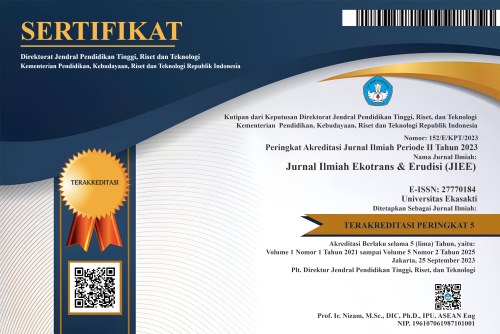
Accreditation and Certificate

Jurnal Ilmiah Ekotrans & Erudisi (JIEE) is a peer-reviewed, open-access scholarly journal published under the institutional auspices of Universitas Ekasakti, Padang, West Sumatra, Indonesia, through the Faculty of Social and Political Sciences in collaboration with the Institute for Research and Community Service (LPPM).
Established in 2021, JIEE provides an academic platform for the publication and dissemination of original scholarly research in public administration, governance, public policy, organizational and management studies, and related social and political sciences.
This Ownership and Management Policy describes the journal's institutional publishing identity, editorial governance structure, management responsibilities, decision-making principles, financial transparency, and commitment to responsible scholarly publishing.
The policy is informed by internationally recognized principles of transparency and best practice in scholarly publishing developed by the Committee on Publication Ethics (COPE), the Directory of Open Access Journals (DOAJ), the Open Access Scholarly Publishing Association (OASPA), and the World Association of Medical Editors (WAME).
JIEE is institutionally affiliated with Universitas Ekasakti, a higher education institution located in Padang, West Sumatra, Indonesia. The journal's publication activities are organized through the Faculty of Social and Political Sciences in collaboration with LPPM Universitas Ekasakti.
The journal operates as an academic publishing platform dedicated to supporting scientific communication, facilitating scholarly exchange, and disseminating research findings relevant to its disciplinary scope.
The journal's institutional identity and bibliographic information are as follows:
| Journal Title | Jurnal Ilmiah Ekotrans & Erudisi (JIEE) |
| Journal Abbreviation | JIEE |
| Institutional Publisher | Universitas Ekasakti |
| Publishing and Managing Units | Faculty of Social and Political Sciences and LPPM Universitas Ekasakti |
| Country | Indonesia |
| Location | Padang, West Sumatra, Indonesia |
| Electronic ISSN | 2777-0184 |
| Print ISSN | 2797-2259 |
| DOI Prefix | 10.69989 |
| Publication Frequency | Biannual (June and December) |
| Publishing Model | Peer-Reviewed Open Access |
| Journal Platform | Open Journal Systems (OJS) |
| Journal Website | https://journal.unespadang.ac.id/JIEE/ |
| University Website | https://www.unespadang.ac.id/ |
The journal's institutional affiliation must be represented accurately in its website, publication metadata, indexing records, editorial documents, and official correspondence. Any formal change in the publishing institution or responsible management unit must be supported by the appropriate institutional authorization and communicated transparently.
The institutional framework for publishing JIEE involves Universitas Ekasakti, the Faculty of Social and Political Sciences, and LPPM Universitas Ekasakti.
Universitas Ekasakti serves as the institutional publishing organization associated with JIEE. Its institutional role provides the organizational context for the journal's academic publishing activities and the development of responsible scholarly communication.
Within the applicable institutional arrangements, the publisher is responsible for supporting the conditions necessary for credible, transparent, and sustainable academic journal management.
These responsibilities include:
The Faculty of Social and Political Sciences is one of the institutional units responsible for the publication and academic development of JIEE.
Its role is associated with the journal's scholarly orientation, disciplinary relevance, academic development, and coordination of editorial activities within the institutional publishing framework.
The faculty's responsibilities, as defined through applicable institutional arrangements, may include coordinating academic publishing activities, facilitating scholarly collaboration, supporting editorial development, and contributing to the continuous improvement of journal quality.
LPPM Universitas Ekasakti collaborates in the publication of JIEE as part of the university's institutional framework for research development and scholarly dissemination.
Its involvement supports the integration of academic publishing with the broader research and scholarly communication activities of Universitas Ekasakti.
Within its authorized institutional role, LPPM may facilitate coordination concerning research dissemination, publication administration, institutional quality assurance, and the development of responsible academic publishing practices.
The specific administrative responsibilities and decision-making authority of the participating institutional units are governed by the applicable organizational arrangements and formally approved journal management procedures.
JIEE maintains an editorial structure consisting of an Editor-in-Chief, Managing Editor, editorial members, and supporting peer reviewers.
The editorial structure is intended to provide scholarly leadership, coordinate manuscript evaluation, maintain publication standards, and support transparent and accountable editorial decision-making.
The current principal editorial positions listed on the journal's official website are:
| Editor-in-Chief | Drs. Tarma Sartima, M.Si., Ph.D. Universitas Ekasakti, Indonesia |
| Managing Editor | Dr. Nika Saputra, S.AP., S.IP., M.A.P. Universitas Ekasakti, Indonesia |
| Editorial Board | National and international scholars appointed to the journal's editorial structure. |
| Peer Reviewers | Scholars and subject specialists involved in independent manuscript evaluation. |
The complete and updated composition of the editorial structure is available on the journal's official Editorial Team page.
Editorial positions and affiliations should be periodically reviewed to ensure that published information accurately reflects the individuals serving the journal and their current institutional affiliations.
The Editor-in-Chief provides scholarly leadership for the journal and bears overall responsibility for the integrity and quality of editorial decision-making.
The principal responsibilities of the Editor-in-Chief include:
The Editor-in-Chief may delegate defined editorial responsibilities to qualified editors, but such delegation must preserve accountability, procedural fairness, and compliance with the journal's approved policies.
The Managing Editor coordinates the operational aspects of manuscript processing and supports communication among authors, editors, reviewers, and the publishing institution.
The Managing Editor's responsibilities include:
Operational coordination does not replace independent scientific evaluation. Decisions concerning the scholarly suitability of manuscripts must remain grounded in the journal's editorial standards and review procedures.
The Editorial Board consists of scholars whose expertise is relevant to the journal's objectives and scope.
Editorial Board members contribute to the development and maintenance of the journal's scholarly standards and may participate in manuscript evaluation, editorial consultation, peer reviewer recommendations, and other academic responsibilities assigned through the editorial process.
Editorial Board responsibilities include:
Editorial Board membership must be based on appropriate expertise, genuine willingness to serve, and adherence to the journal's editorial policies.
Membership alone does not establish evidence of editorial activity. The journal should maintain appropriate records of actual editorial contributions and periodically review the composition and effectiveness of its editorial structure.
JIEE adopts the principle that editorial decisions must be independent of inappropriate institutional, financial, commercial, political, or personal influence.
The evaluation and acceptance of manuscripts must be based on scholarly relevance, originality, methodological appropriateness, analytical quality, ethical compliance, and the assessments obtained through the editorial process.
The publisher's institutional relationship with the journal does not confer authority to require the acceptance or rejection of a manuscript for reasons unrelated to its scholarly merits.
Editorial decisions must not be influenced by:
Members of the editorial team must disclose relevant conflicts of interest and withdraw from editorial decision-making where their independence or impartiality could reasonably be compromised.
Manuscripts submitted by editors, editorial board members, or individuals with institutional or personal relationships to the journal must be evaluated through appropriate independent editorial arrangements.
JIEE employs a double-blind peer review model as stated in its published editorial policy.
The peer review process is intended to provide independent scientific assessment of manuscripts before publication.
The editorial management is responsible for ensuring that reviewer selection is based on relevant scholarly expertise, that review procedures maintain appropriate confidentiality, and that editorial decisions consider the quality and substance of reviewer evaluations.
Quality assurance responsibilities include:
Peer review recommendations inform editorial decisions but do not automatically determine manuscript acceptance. The responsible editor must evaluate the available evidence and make decisions consistent with the journal's editorial policies.
Further details are provided in the Peer Review Process.
JIEE recognizes that transparency concerning publishing charges, institutional support, and other relevant financial arrangements is necessary to maintain public trust and editorial accountability.
According to the journal's published Article Processing Charge policy, JIEE does not charge a manuscript submission fee. A publication fee of IDR 500,000 is specified for accepted articles, and the journal provides an opportunity to request a fee waiver subject to its published conditions.
All applicable author charges must be disclosed clearly and consistently through the journal's official website.
Financial considerations must not determine manuscript acceptance, rejection, reviewer recommendations, or the scientific content of published articles.
The management of publication-related financial transactions must follow the applicable institutional and administrative requirements of the publisher.
Any institutional funding, external sponsorship, advertising income, or other material source of publishing support, where applicable, should be disclosed accurately and must not compromise editorial independence.
Further information is available in the Article Processing Charge policy.
The publisher and editorial management share responsibility for supporting ethical scholarly communication and protecting the integrity of the published scientific record.
JIEE's published ethical framework addresses responsibilities of authors, editors, and reviewers, including matters concerning originality, plagiarism, research misconduct, authorship, confidentiality, and conflicts of interest.
Management responsibilities concerning publication ethics include:
Concerns involving research misconduct or the reliability of published findings should be handled in accordance with the journal's established policies and relevant guidance from COPE.
The journal's ethical standards are described in the Publication Ethics policy.
JIEE operates under an open-access publishing model intended to make scholarly articles freely accessible to readers.
The journal's published copyright policy states that authors retain copyright and grant JIEE the right of first publication.
Published articles are subject to the journal's stated Creative Commons Attribution-ShareAlike 4.0 International License (CC BY-SA 4.0), as described in its copyright policy.
The publisher and editorial management are responsible for ensuring that information concerning copyright, licensing, access, and reuse conditions is presented clearly and consistently across the journal website and published article formats.
Copyright and licensing terms must be communicated transparently and should not be modified retrospectively in a manner that misrepresents the rights applicable to previously published works.
For further information, please consult the Copyright Notice.
JIEE uses the Open Journal Systems (OJS) platform to support the administration of scholarly manuscript submission, editorial processing, peer review, publication, and online dissemination.
The editorial management is responsible for maintaining accurate publication information within the scope of its authority, including:
Appropriate administrative controls should be used to protect confidential editorial records and to maintain the reliability of information provided through the journal's publishing platform.
The publisher and editorial management should periodically review arrangements for maintaining publication accessibility, metadata accuracy, electronic backups, and long-term preservation in accordance with available institutional systems and the journal's formally adopted archiving policy.
JIEE recognizes the importance of providing appropriate channels through which authors, reviewers, readers, and other interested parties may raise concerns concerning editorial procedures, publication ethics, or the reliability of published material.
Complaints and appeals should be considered objectively, confidentially where appropriate, and without retaliation against individuals who raise concerns in good faith.
Concerns directly involving an editor should be referred to another appropriately authorized and independent editorial representative. Where an issue requires institutional investigation, the journal may seek assistance from the responsible institutional authority.
Editorial actions should be proportionate to the evidence available and consistent with the journal's policies and applicable ethical guidance.
The journal should maintain sufficient documentation of significant complaints, appeals, investigations, decisions, and corrective actions to support institutional accountability and continuous improvement.
JIEE is committed to improving transparency, editorial professionalism, scholarly quality, and the sustainability of its publishing activities.
The publisher and editorial management should periodically evaluate:
Where deficiencies are identified, appropriate corrective actions should be documented and implemented in accordance with the authority and resources available to the journal management.
Changes in institutional publishing responsibility, editorial leadership, management structure, or significant publication policies should be reflected accurately on the journal website.
Jurnal Ilmiah Ekotrans & Erudisi (JIEE)
Faculty of Social and Political Sciences and LPPM
Universitas Ekasakti
Padang, West Sumatra, Indonesia
Institutional Website:
https://www.unespadang.ac.id/
Journal Website:
https://journal.unespadang.ac.id/JIEE/
Editorial Team:
JIEE Editorial Team
Official Journal Contact:
Contact and Editorial Correspondence
The principles described in this policy are informed by the following sources:
Policy Adoption and Review: This policy is intended to be implemented following formal approval by the responsible JIEE management. The journal should review the policy periodically and update the published information when relevant institutional or editorial arrangements change.
Accreditation and Certificate
Template


Support By



Tools