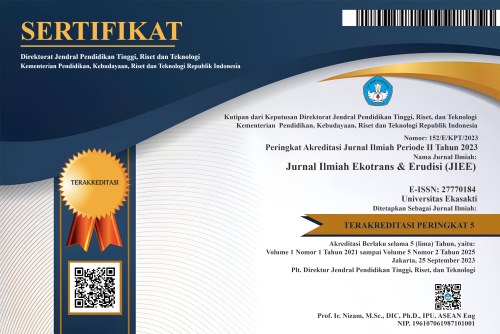
Accreditation and Certificate

Jurnal Ilmiah Ekotrans & Erudisi (JIEE) publishes scholarly manuscripts that advance theoretical, empirical, methodological, and policy-oriented knowledge in public administration, governance, public policy, organizational and management studies, and related social and political sciences.
The journal welcomes scientifically rigorous manuscripts that demonstrate originality, analytical depth, methodological transparency, and a meaningful contribution to existing scholarship. Submissions must be consistent with the journal's stated objectives and scope and comply with its ethical and editorial requirements.
JIEE recognizes several categories of scholarly manuscripts, as described below. Regardless of manuscript type, all submissions are subject to editorial screening and, where appropriate, independent peer review. Acceptance is determined by scholarly quality, relevance, originality, and compliance with the journal's publication standards.
Original Research Articles report original empirical investigations that contribute new evidence, explanations, interpretations, or theoretical insights to the fields covered by JIEE.
These articles should address a clearly defined research problem, engage critically with relevant scholarship, apply appropriate and transparent research methods, and present findings that contribute meaningfully to scientific knowledge.
Original Research Articles may employ a range of scientifically justified methodological approaches, including:
Methodological diversity is encouraged; however, the choice of methods must be consistent with the research objectives, theoretical framework, available evidence, and claims presented in the manuscript.
Sections may be combined or adapted where necessary to reflect disciplinary conventions and the chosen research design, provided that methodological transparency, analytical coherence, and the completeness of scientific reporting are maintained.
Original Research Articles are evaluated based on the significance of the research problem, originality of the contribution, quality of theoretical engagement, appropriateness of research methods, adequacy of supporting evidence, analytical depth, and consistency between findings and conclusions.
Studies that merely describe local administrative or organizational conditions without developing a meaningful analytical argument or scholarly contribution may be considered insufficient for publication.
Review Articles provide systematic, critical, and analytically integrated assessments of existing scholarly knowledge concerning a clearly defined research topic.
Review manuscripts should contribute to scientific understanding by synthesizing evidence, identifying conceptual or methodological developments, explaining inconsistencies in previous findings, evaluating theoretical perspectives, or developing new research propositions and analytical frameworks.
JIEE considers review studies that employ transparent, reproducible, and scientifically appropriate approaches to identifying, selecting, evaluating, and synthesizing relevant literature.
Review manuscripts must demonstrate more than a descriptive summary of previous publications. They should provide a clear analytical synthesis and identify how the review advances existing scientific knowledge.
Authors are expected to follow appropriate reporting standards relevant to their review design. Systematic reviews and meta-analyses should consider applicable PRISMA reporting guidance. Scoping reviews may use PRISMA-ScR or other appropriate methodological standards.
Where bibliometric techniques are employed, authors should report the bibliographic database, search strategy, search date, inclusion and exclusion criteria, dataset preparation, analytical software, and the interpretation of resulting networks or thematic structures.
The use of a single bibliographic database must be justified in relation to the objectives and limitations of the review.
Authors should distinguish between descriptive mapping, quantitative synthesis, and theoretical interpretation. Claims regarding research trends, scholarly influence, or scientific contributions must be supported by the evidence and analytical procedures employed.
Review Articles are evaluated according to the importance of the research question, transparency and appropriateness of the review methodology, quality and coverage of the evidence, depth of critical synthesis, originality of the resulting insights, and significance of the contribution to scholarship.
Reviews consisting primarily of descriptive publication counts, keyword frequencies, or unsystematic summaries without a substantial analytical contribution may not meet the journal's scientific standards.
Conceptual and Theoretical Articles develop, critically examine, refine, or extend concepts, theoretical perspectives, explanatory models, and analytical frameworks relevant to the journal's disciplinary scope.
These manuscripts are expected to contribute to scientific knowledge through systematic theoretical reasoning, critical engagement with foundational and contemporary literature, and the development of original conceptual insights.
Conceptual and theoretical scholarship does not necessarily require the collection of new empirical data. However, the argument must be based on rigorous academic reasoning, credible scholarly evidence, and a transparent explanation of how the proposed contribution advances existing knowledge.
Conceptual and Theoretical Articles may include:
Conceptual and Theoretical Articles are assessed according to conceptual clarity, originality, analytical coherence, theoretical significance, engagement with existing literature, and the strength of the logical argument.
Manuscripts that consist predominantly of personal opinion, general commentary, normative assertions, or descriptive literature summaries without a systematic scholarly argument are not considered sufficient as conceptual contributions.
Policy and Governance Analysis Articles examine public policies, governance arrangements, institutional mechanisms, administrative systems, or regulatory interventions through systematic and evidence-based analysis.
This manuscript category is particularly relevant to JIEE's scholarly interest in public administration, public policy, institutional development, governance reform, public accountability, and organizational performance.
Policy and governance analysis should go beyond describing government programs or administrative regulations. Authors must critically evaluate relevant policy problems, institutional relationships, implementation mechanisms, policy outcomes, or governance alternatives using transparent analytical approaches.
Policy and Governance Analysis Articles are evaluated based on the importance of the policy problem, transparency of the evidence, appropriateness of the analytical approach, strength of institutional or policy explanations, engagement with relevant theories, and contribution to policy and governance scholarship.
Policy recommendations must be directly supported by the findings and should account for relevant implementation conditions, institutional constraints, and limitations of the evidence.
Manuscripts consisting primarily of descriptive legal summaries, general policy opinions, or administrative reports without systematic analysis may be considered unsuitable for publication.
All manuscript types must comply with the journal's approved Author Guidelines, publication ethics, peer review procedures, and relevant editorial policies.
The journal's current Author Guidelines specify a manuscript length of 4,000–8,000 words, including the abstract, references, and footnotes. Manuscripts should be prepared using the official JIEE template and submitted in an editable Microsoft Word format.
Where a particular review or theoretical manuscript requires additional space to report essential methodological information or supporting analyses, authors should consult the editorial office before submission. Any exception to the prescribed length requires editorial authorization.
Each manuscript must include an informative abstract of 100–200 words that reflects its research or analytical design.
For empirical research, the abstract should identify the research objective, methods, key findings, and contribution. For review articles, it should identify the review objective, evidence sources or review method, major synthesis findings, and implications. For conceptual and policy analysis articles, it should summarize the central problem, analytical approach, principal argument or findings, and scholarly contribution.
Each manuscript should include no more than five keywords or key phrases suitable for academic indexing and information retrieval.
Manuscripts must comply with the language requirements established in the journal's current approved Author Guidelines. Authors are responsible for ensuring clarity, accuracy, consistency, and appropriate academic language throughout the manuscript.
Authors whose manuscripts contain substantial grammatical, structural, or linguistic problems may be required to revise the text before further editorial evaluation.
All manuscript types must follow the journal's prescribed American Psychological Association (APA) reference style.
Authors should prioritize relevant, credible, and up-to-date scholarly literature while appropriately acknowledging foundational studies when necessary.
All cited references must be included in the reference list, and all entries in the reference list must correspond to sources cited in the manuscript.
Authors are responsible for verifying bibliographic information, including author names, publication dates, journal titles, volume and issue numbers, page ranges, and DOI links where available.
The journal encourages the use of reference management applications to improve citation accuracy and consistency.
Authors must ensure that submitted manuscripts comply with applicable research ethics requirements and accurately represent the research activities conducted.
Where relevant, manuscripts should include information concerning:
All authors remain responsible for the accuracy, originality, integrity, and ethical compliance of their submissions.
JIEE prioritizes manuscripts that make identifiable scholarly contributions. The following types of submissions are generally not suitable for publication unless they are substantially developed into an appropriate research article:
The journal evaluates interdisciplinary contributions on the basis of their scholarly relevance and explanatory contribution rather than disciplinary labels alone.
All manuscripts undergo an initial editorial screening to assess their suitability for JIEE.
The screening considers alignment with the journal's objectives and scope, manuscript type, originality, methodological or analytical rigor, completeness of the submission, adherence to formatting requirements, and compliance with research ethics.
Manuscripts that do not satisfy essential editorial requirements may be returned for correction or declined without external review.
Manuscripts considered suitable for further evaluation are processed through the journal's established double-blind peer review system. Reviewers are selected according to their relevant scholarly expertise and are expected to evaluate the manuscript objectively and constructively.
Editorial decisions are based on the scientific merits of the manuscript, the reviewers' evaluations, the adequacy of author revisions, and the journal's publication standards.
Submission of a manuscript does not guarantee acceptance or publication. The final publication decision rests with the responsible editor in accordance with the journal's editorial policies.
All manuscripts must be submitted electronically through the official JIEE Open Journal Systems (OJS) platform.
Before submission, authors should:
Where the OJS submission system provides a single section named Articles, eligible manuscripts may be submitted through that section, with the appropriate manuscript type identified in the submission information or communicated to the editorial office.
Authors are encouraged to consult the following journal policies and resources before submitting their manuscripts:
This Manuscript Types Policy provides a framework for identifying and evaluating scholarly submissions to JIEE. It becomes effective following its formal approval and publication by the journal's editorial management.
The editorial team may periodically review and revise the accepted manuscript categories and related requirements to reflect developments in research methodology, publication ethics, disciplinary scholarship, and international standards of scholarly communication.
Any material changes to manuscript eligibility, submission requirements, or editorial procedures should be communicated transparently through the journal's official website.
Accreditation and Certificate
Template


Support By



Tools