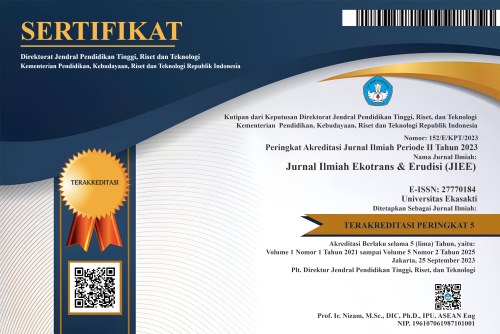
Accreditation and Certificate
Jurnal Ilmiah Ekotrans & Erudisi (JIEE) is committed to promoting original scholarship, responsible citation practices, transparent research reporting, intellectual property protection, and the integrity of the scholarly publication record.
Plagiarism, inappropriate textual appropriation, misleading attribution, and the misrepresentation of another person's intellectual contributions as one's own are unacceptable in manuscripts submitted to or published by JIEE.
The journal uses Turnitin as part of its manuscript similarity screening procedure. Similarity checking supports editorial assessment but does not independently establish whether plagiarism has occurred.
This policy defines unacceptable forms of plagiarism and related originality violations, explains how similarity reports are evaluated, establishes proportionate editorial procedures, and clarifies the responsibilities of authors, editors, and reviewers.
The policy is informed by the Committee on Publication Ethics (COPE) Core Practices and relevant guidance on suspected plagiarism in submitted manuscripts and published articles.
The purposes of this policy are to:
This policy applies to all manuscript types, authors, editors, reviewers, and other individuals involved in the journal's scholarly publication process.
Plagiarism occurs when an individual uses or presents another person's words, ideas, research findings, data, methods, interpretations, images, or other intellectual contributions without appropriate acknowledgment, in a manner that misrepresents their origin or authorship.
Plagiarism may involve direct copying, substantial paraphrasing, translation, unauthorized appropriation of intellectual content, or other practices that conceal the source of scholarly material.
Plagiarism may occur even when the source is publicly accessible, freely available, or distributed under an open-access license.
Proper attribution is required whenever scholarly material is derived from an identifiable source, except where the information genuinely constitutes widely recognized common knowledge.
Authors must accurately distinguish their original work from intellectual contributions previously developed by others.
Direct plagiarism involves reproducing another person's text without appropriate quotation, citation, or acknowledgment.
Copying substantial text from journal articles, books, dissertations, reports, websites, or unpublished works without proper attribution is prohibited.
Paraphrasing plagiarism occurs when an author reproduces another source's ideas, argument structure, reasoning, or substantive content through superficial wording changes without acknowledging the original source.
Replacing words with synonyms or changing sentence order does not eliminate the requirement for attribution.
Using another researcher's original theory, conceptual model, analytical framework, hypothesis, interpretation, or distinctive scholarly argument without acknowledgment constitutes inappropriate intellectual appropriation.
Authors must cite the source of relevant ideas even when they independently develop or extend those ideas in a new context.
Presenting another researcher's datasets, interview findings, survey results, experimental observations, documentary evidence, statistical analyses, or other empirical findings as original research is prohibited.
Secondary data analysis is permissible when the data source, access conditions, methodological approach, and original contribution are disclosed appropriately.
Translation plagiarism occurs when text, arguments, or other intellectual material from a source in one language is translated into another language and presented without proper attribution.
Translation does not transform another person's intellectual contribution into original authorship.
Mosaic plagiarism involves combining copied phrases, paraphrased passages, or ideas from multiple sources into a manuscript without adequately identifying the original contributions.
The practice remains unacceptable even when individual sentences have been modified.
Reproducing or adapting tables, figures, diagrams, conceptual models, maps, images, or other visual materials without appropriate acknowledgment constitutes an originality violation.
Authors must also comply with relevant copyright, licensing, and third-party permission requirements.
Reusing substantial portions of previously published content, including one's own work, without appropriate disclosure or citation may constitute unacceptable textual recycling, redundant publication, or another publication ethics concern.
Such cases must be evaluated according to their context and must not automatically be classified as plagiarism of another person's work.
All authors are responsible for ensuring that submitted manuscripts present an authentic and appropriately attributed scholarly contribution.
Before submission, authors must:
Authors must not knowingly submit manuscripts containing fabricated references, misappropriated intellectual material, or misleading claims of originality.
The corresponding author must communicate applicable originality requirements to all co-authors and ensure that the complete manuscript has been approved for submission.
Authors must acknowledge sources whenever previously published or unpublished intellectual contributions are used to support the manuscript.
Accurate citation is required for:
Direct quotations must follow the journal's applicable APA referencing requirements.
Authors must not omit citations merely because a text has been translated, summarized, or reworded.
Accurate citation does not automatically resolve copyright restrictions or justify excessive reproduction of protected material.
JIEE distinguishes plagiarism of another person's work from the reuse of an author's own previously disseminated material.
Textual recycling may raise concerns when substantial material is reproduced without sufficient disclosure, appropriate citation, or justification.
Editors should evaluate the nature, location, extent, and scholarly significance of repeated material.
Limited reuse of conventional methodological descriptions or standard terminology may be legitimate when necessary for accurate research reporting and when relevant source acknowledgment is provided.
By contrast, substantial undisclosed reuse of previously published results, analyses, discussions, or conclusions may compromise the originality of a submitted manuscript.
Authors must disclose relevant overlap with previous publications and explain the new contribution of the submitted work.
JIEE does not permit the simultaneous submission of substantially the same manuscript to another journal.
Redundant publication occurs when substantially overlapping scholarly work is presented as a separate original contribution without adequate disclosure, justification, or acknowledgment.
Possible concerns include:
Research derived from a dissertation, thesis, conference presentation, working paper, institutional report, or larger research project is not automatically considered plagiarism or duplicate publication.
Such manuscripts must be assessed according to the extent of previous dissemination, transparency of disclosure, originality of contribution, and applicable editorial and publishing requirements.
JIEE recognizes that research may have been disseminated through academic repositories, preprint servers, dissertations, theses, conference materials, or other legitimate scholarly channels before journal submission.
Previous dissemination does not automatically constitute plagiarism.
Authors must disclose relevant prior versions when necessary to allow the editorial team to assess originality, publication history, and possible overlap.
The editor may request information about earlier versions, related manuscripts, or publication agreements.
A manuscript derived from an earlier academic work must demonstrate the scholarly contribution required by JIEE and must comply with applicable intellectual property and ethical requirements.
Authors must not conceal substantive previous publication merely to avoid similarity detection.
JIEE uses Turnitin as part of the manuscript originality and similarity screening process.
Similarity screening assists editorial personnel in identifying textual overlap that may warrant closer examination.
The screening process may be conducted during initial editorial evaluation and repeated at later stages when substantial revisions, new concerns, or other relevant circumstances justify additional assessment.
Turnitin reports may identify overlap involving:
The identification of matching text does not establish that plagiarism has occurred.
Similarity screening must be accompanied by an informed evaluation of the sources and context of the matching material.
JIEE does not treat a Turnitin similarity percentage as automatic proof of plagiarism or originality.
Similarity reports must be interpreted in context by the responsible editor.
Relevant considerations include:
A manuscript with a relatively low similarity score may still contain serious plagiarism if important intellectual material is misappropriated.
Conversely, a manuscript with a relatively high similarity score may contain legitimate overlap involving appropriately cited sources, standard methods, or previously disclosed research materials.
The journal does not establish an automatic acceptance or rejection rule based solely on a numerical similarity score.
Under this policy, originality decisions must be based on qualitative assessment of the evidence rather than an unverified or arbitrary similarity threshold.
No universal numerical Turnitin threshold is established as a definitive indicator of plagiarism.
If the journal subsequently adopts operational screening indicators, these must be formally authorized, applied consistently, and interpreted as preliminary review criteria rather than conclusive evidence of misconduct.
Editors must not assume that reducing a similarity percentage necessarily resolves all originality concerns.
Authors must not manipulate formatting, punctuation, character encoding, or wording merely to evade similarity detection.
Appropriate correction requires genuine rewriting, accurate acknowledgment, removal of inappropriate overlap, or other substantive measures relevant to the identified concern.
When a manuscript is submitted, the editorial office assesses its compliance with the journal's submission and originality requirements.
The plagiarism and similarity screening workflow includes:
Similarity screening is an editorial quality-control process and does not replace independent scientific peer review.
A manuscript may proceed when identified overlap is appropriately attributed, reflects legitimate scholarly conventions, or otherwise does not indicate a significant originality problem.
The editorial team may still request ordinary corrections to citation or formatting.
Minor problems may include isolated insufficiently attributed phrases, quotation formatting errors, or limited textual overlap that does not materially misrepresent authorship or original research contributions.
The editor may request rewriting, correct quotation, additional citation, or appropriate source acknowledgment.
More serious concerns may include extensive unattributed copying, substantial disguised paraphrasing, misleading reuse of previously published analyses, or substantial overlap that undermines the manuscript's claimed contribution.
The editorial team may suspend review, request clarification, seek additional expert assessment, or reject the manuscript when the concern is sufficiently substantiated.
Where evidence suggests deliberate appropriation of intellectual contributions, fabricated research evidence, systematic misrepresentation, or other serious misconduct, the journal may initiate an appropriate research integrity assessment.
Editors must distinguish established facts from unresolved allegations.
Authors must ordinarily be given a reasonable opportunity to respond to substantive allegations of plagiarism or serious originality violations.
The editorial office should communicate the relevant concern in neutral, professional, and sufficiently specific terms.
Where appropriate, authors may be requested to provide:
Authors must provide accurate information and must not submit fabricated documentation or misleading explanations.
The editorial office must evaluate the response objectively and avoid treating an allegation as proof of misconduct before the relevant evidence has been assessed.
Where concerns are identified before publication, the journal may take actions proportionate to their nature, seriousness, and evidentiary support.
Possible actions include:
Editorial actions must not be determined solely by the numerical similarity percentage.
Where appropriate, the editor should explain the principal reasons for the decision and document the relevant assessment.
JIEE acknowledges that concerns about plagiarism or the originality of research may emerge after an article has been published.
Post-publication allegations may arise from readers, authors, reviewers, researchers whose work has allegedly been copied, editorial personnel, or other credible sources.
The editorial office should assess such concerns according to the available evidence and their implications for the reliability and integrity of the published article.
The assessment may include:
Published articles must not be silently replaced to conceal serious originality concerns or substantive corrections.
Post-publication actions must be determined according to the nature and consequences of the identified problem.
A correction may be appropriate when a limited attribution error or other correctable problem is identified and the overall findings and conclusions remain reliable.
The correction must clearly explain the relevant change and preserve transparency concerning the scholarly record.
An Expression of Concern may be considered when credible concerns significantly affect confidence in a published article but the available evidence remains unresolved or further investigation is necessary.
An Expression of Concern must not be used as a substitute for a justified final editorial action once sufficient evidence becomes available.
Retraction may be appropriate where substantial plagiarism, unacceptable redundant publication, misappropriated research evidence, or another serious integrity violation undermines the article's reliability or the legitimacy of its publication.
Retraction decisions must be based on sufficient evidence and implemented through a transparent notice linked to the affected article.
Retraction is intended to correct the scholarly record rather than serve automatically as a punishment.
JIEE recognizes that AI-assisted tools can generate or transform scholarly text but may also produce inaccurate statements, fabricated references, or unattributed material.
Authors remain responsible for all content submitted under their names, including AI-assisted material.
Authors must:
AI-generated material must not be used to fabricate research findings, disguise copied text, generate fictitious references, or evade originality assessment.
Automated AI-detection scores are not conclusive evidence of misconduct and must not independently determine editorial decisions.
Editors are responsible for implementing plagiarism screening and originality assessment fairly, consistently, and independently.
Editors must:
Editors must not use similarity reports selectively to favor or disadvantage particular authors.
The journal's originality standards apply equally to submissions involving editorial board members, institutional colleagues, or other individuals associated with the publisher.
Peer reviewers should remain attentive to potential originality concerns encountered during scientific evaluation.
Reviewers who identify substantial unattributed overlap, suspicious duplication, or other credible integrity concerns must communicate the issue confidentially to the responsible editor.
Reviewers should provide specific information or relevant sources where possible.
Reviewers must not make public allegations, contact alleged original authors independently without appropriate editorial authorization, or disclose confidential manuscripts to unauthorized services.
Peer reviewers must comply with the journal's prohibition on using AI in the manuscript review process.
Reviewers may recommend additional examination but do not independently determine that misconduct has occurred.
Similarity screening and the assessment of alleged plagiarism must respect the confidentiality of unpublished manuscripts and protected research information.
Editors and authorized personnel must use appropriate institutional arrangements and approved tools for originality screening.
Manuscripts, reports, confidential correspondence, and supporting research information must not be disclosed to unauthorized individuals.
Where a similarity screening service involves external processing or storage of manuscript content, its use must comply with applicable confidentiality, institutional, and data protection requirements.
Information concerning an unresolved allegation should be shared only with persons whose involvement is reasonably necessary for fair editorial assessment or authorized investigation.
Authors may submit a reasoned appeal if they believe a plagiarism-related decision resulted from a material factual error, failure to consider relevant evidence, unmanaged conflict of interest, or significant procedural irregularity.
Appeals must identify the specific concern and provide relevant supporting information.
An appeal should be considered by the Editor-in-Chief or, where a conflict exists, another appropriately authorized independent editor.
Individuals reporting suspected plagiarism should provide sufficient information to enable meaningful assessment.
Concerns raised in good faith must be considered fairly and without retaliation.
The journal must distinguish malicious or unsupported allegations from credible evidence requiring further assessment.
Complaints and appeals may be submitted through the JIEE Editorial Office.
JIEE publishes scholarly articles under its applicable open-access licensing arrangements, including the Creative Commons Attribution-ShareAlike 4.0 International License (CC BY-SA 4.0).
Open access permits lawful reuse under the relevant license conditions but does not authorize misrepresentation of authorship or removal of required attribution.
Authors and other users must acknowledge intellectual contributions appropriately and comply with applicable license terms.
Even when a license permits reproduction or adaptation, scholarly citation remains necessary to avoid misleading representations of intellectual origin.
Relevant requirements are described in the journal's Copyright Notice and Open Access Policy.
JIEE should maintain appropriate documentation of substantive similarity screening outcomes, author explanations, editorial assessments, and decisions relevant to manuscript originality.
Documentation may include:
Such documentation supports editorial accountability and legitimate quality assurance assessment.
Records must reflect actual procedures undertaken and must not be fabricated or retrospectively represented as having existed at an earlier stage.
This Plagiarism Policy is part of JIEE's integrated publication ethics framework and should be read in conjunction with:
Relevant international resources include:
These resources inform the journal's ethical approach. Their inclusion does not imply formal organizational membership, accreditation, certification, or endorsement.
This Plagiarism Policy becomes effective following formal approval and publication by the responsible JIEE editorial management.
The editorial team should implement approved originality screening requirements consistently through manuscript submission, editorial evaluation, peer review, and post-publication assessment.
The journal should periodically review this policy in response to developments in publication ethics, similarity screening technologies, open-access licensing, and research integrity standards.
Substantive policy changes should be communicated transparently through the journal's official website.
JIEE is committed to protecting intellectual integrity through original scholarship, responsible attribution, transparent similarity screening, proportionate editorial action, and fair treatment of all parties.
Accreditation and Certificate
Template


Support By


Tools